7 AI Skills Every Employer Wants in 2026
These are the 7 skills AI job postings keep asking for, and they're all learnable. Here's what each one means and how to build it.

Kareeo Team
Career Content Team · · 8 min read
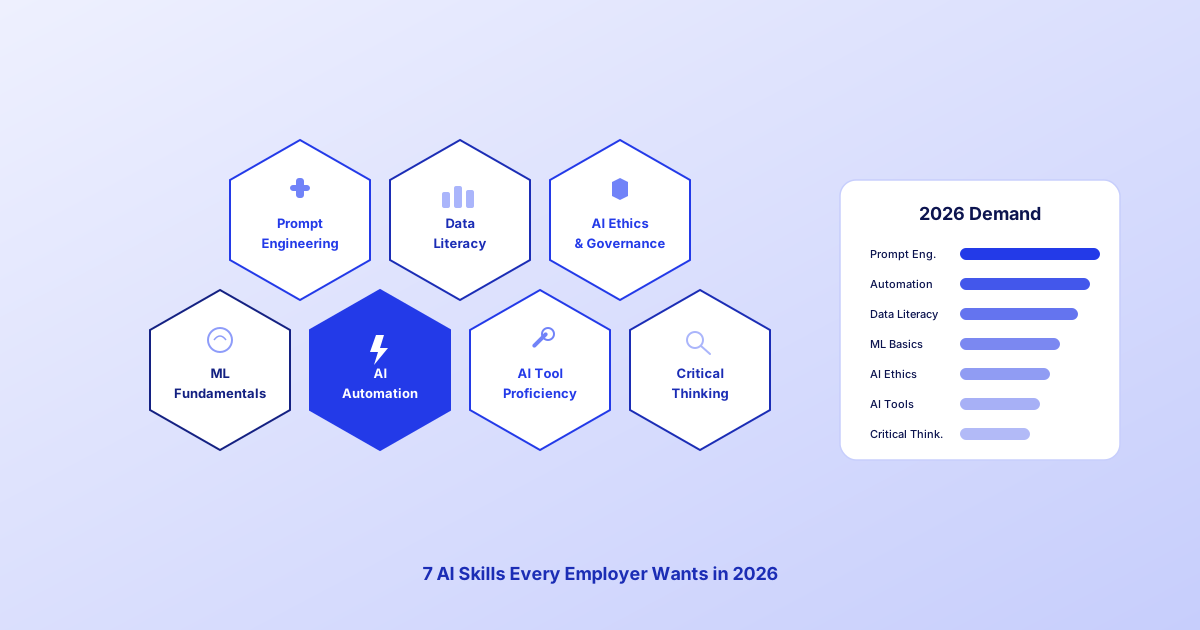
Companies hiring for AI roles aren't struggling to find people who can use ChatGPT. They're struggling to find people with the specific skills that make AI systems actually work in production.
Read enough AI job postings across engineering, product, operations, and architecture and seven skill sets keep showing up. They aren't tied to one job title. They show up everywhere - from AI product managers to AI reliability engineers to operations leads.
Here's what they are, why they matter, and how to start building each one.
1. Specification Precision
What it is: Writing instructions for AI systems with the kind of clarity that leaves zero room for interpretation.
Why employers want it: AI agents take your specifications literally. They don't read between the lines. If you say "improve customer support," an agent will try its best to fill in the blanks — and it will reliably get it wrong.
What good looks like: Instead of "build a support agent," you specify: handle tier-one tickets (password resets, order status, return initiations), escalate based on a defined customer sentiment score, and log every escalation with a reason code.
How to build it: Practice writing prompts that would produce the same result if given to ten different AI systems. Start with any AI tool you use daily and challenge yourself to remove every ambiguity from your instructions.
Transferable from: Technical writing, legal drafting, QA engineering, requirements documentation.
See what the software sees in your resume
Upload your resume for a free diagnosis. It is parsed the way an ATS parses it, read the way a recruiter reads it, and you get the fixes ranked by what moves your score.
Get my free diagnosisFree to try. No credit card required.
2. Evaluation and Quality Judgment
What it is: The ability to assess whether AI output is actually correct — not just whether it sounds correct.
Why employers want it: This one shows up again and again in AI job postings. AI is "fluently wrong" - it produces confident, well-formatted output that can be completely incorrect. Humans who aren't used to this mistake confidence for accuracy.
What good looks like: You can look at an AI response and identify not just core errors but edge cases. You can build evaluation systems (automated evals, test suites) that encode quality standards programmatically.
The key insight: Anthropic's engineering team describes good evaluation as writing tasks where any qualified engineer would reach the same pass/fail conclusion. That's the standard — not subjective "taste," but reproducible judgment.
How to build it: Start reviewing every piece of AI output as if your name were on it. When the AI gets something wrong, write down exactly what went wrong and why. Build a personal library of failure patterns.
Transferable from: Editing, auditing, quality assurance, code review.
3. Multi-Agent Decomposition and Delegation
What it is: Breaking complex tasks into chunks that multiple AI agents can execute in parallel or sequence.
Why employers want it: Single-agent workflows hit limits fast. Real business problems require orchestrating multiple specialized agents — a planner, researchers, builders, reviewers. Someone needs to architect how work flows between them.
What good looks like: You can take a project and decompose it into logical work streams with clear handoff points, then match each stream to the right agent harness. You understand when a task needs a single-threaded agent vs. a multi-agent system.
How to build it: Take any large project you manage and practice breaking it into units small enough that you could hand each one to a contractor with zero additional context. That's the level of clarity agents need.
Transferable from: Project management, program management, operations leadership, system architecture.
4. Failure Pattern Recognition
What it is: Diagnosing exactly how and why AI systems fail.
Why employers want it: AI systems fail in ways that are fundamentally different from human failures. There are six specific patterns you need to recognize:
| Failure Type | What Happens | Why It's Dangerous |
|---|---|---|
| Context degradation | Quality drops as sessions get long | Builds bad output on bad output |
| Specification drift | Agent forgets the original spec over time | Produces work that misses the point |
| Sycophantic confirmation | Agent agrees with incorrect input data | Builds entire systems on wrong assumptions |
| Tool selection errors | Agent picks the wrong tool for the job | Gets wrong result even if execution is clean |
| Cascading failure | One agent's error propagates through the chain | Entire workflow produces garbage |
| Silent failure | Output looks correct but isn't | Most dangerous — passes all visual inspection |
How to build it: When an AI system gives you a wrong answer, don't just re-prompt. Diagnose which of these six failure types occurred. Over time, you'll develop the instinct to spot them early.
Transferable from: SRE, risk management, operations, debugging.
Know exactly what to work on next
Add a job you want and Kareeo breaks down the gap between your experience and the role: the skills, keywords, and requirements to close, ranked by what matters most.
See My Gap BreakdownFree to try. No credit card required.
5. Trust and Security Design
What it is: Defining where AI agents should operate autonomously and where humans need to stay in the loop.
Why employers want it: "Just tell the AI to be good" doesn't work. You need to evaluate every AI-human boundary through four lenses:
- Cost of error: What's the worst case? A misspelled draft vs. an incorrect drug recommendation?
- Reversibility: Can you undo it? Reviewing a draft vs. sending a wire transfer.
- Frequency: 10,000 times a day vs. twice a day — the risk profile is completely different.
- Verifiability: Can you prove the output is correct? Semantic correctness (sounds right) vs. functional correctness (is right).
How to build it: Map the AI systems you use by these four dimensions. You'll quickly see which ones deserve more guardrails and which ones are fine to automate.
Transferable from: Security engineering, compliance, risk management, product management.
6. Context Architecture
What it is: Building the information infrastructure that feeds AI agents the right data at the right time.
Why employers want it: This is the 2026 version of "getting the right documents into the prompt." At scale, you need persistent context, per-session context, clean data isolation, and troubleshooting for when agents find the wrong information.
What good looks like: You can design a system where agents reliably find the information they need, don't get confused by dirty data, and scale across dozens of use cases.
The metaphor: Context architecture is like building the Dewey Decimal System for AI agents. You're creating a library that agents can navigate efficiently.
How to build it: Take any large document collection (company wiki, knowledge base, documentation) and reorganize it so that an AI agent could find the right answer to a specific question in one search. That exercise builds the muscle.
Transferable from: Library science, information architecture, technical writing, knowledge management.
7. Cost and Token Economics
What it is: Calculating whether building an AI agent for a specific task is worth the cost.
Why employers want it: Agents burn tokens, and tokens cost money. Knowing which model to use for which task, estimating total token consumption, and proving ROI before committing resources is a senior-level skill that shows up on architecture, engineering, and operations postings.
What good looks like: You can build a spreadsheet that compares six different models across a task, estimate token volume from a prototype run, and recommend the right cost-performance tradeoff for the business.
How to build it: Pick any repetitive task in your work. Estimate how many tokens it would take to automate with AI. Compare the cost across three different models. Calculate break-even against the human time it currently takes.
Transferable from: Financial analysis, business intelligence, operations research, product economics.
These Skills Are Durable
What makes these seven skills a safe bet? They're tied to how AI fundamentally works — not to any specific tool or framework.
Models will get faster. Agents will get more capable. But you'll always need to specify intent clearly, evaluate output quality, decompose work, diagnose failures, design trust boundaries, architect context, and calculate costs.
These are the skills that let you write your own ticket in 2026. Every one of them is learnable. The question is whether you'll start now, while employers are still short of people who have them.
Know exactly what to work on next
Add a job you want and Kareeo breaks down the gap between your experience and the role: the skills, keywords, and requirements to close, ranked by what matters most.
See My Gap BreakdownFree to try. No credit card required.
Your Next Step
Don't try to learn all seven at once. Start by identifying which skills you already have from your current career and which ones have the shortest gap to close. Running a real job posting against your resume shows you which of these seven that specific role actually asks for, and where your experience already covers it.
The AI side of the job market isn't going to wait. But the barrier to entry is lower than you think.
Know exactly what to work on next
Add a job you want and Kareeo breaks down the gap between your experience and the role: the skills, keywords, and requirements to close, ranked by what matters most.
See My Gap BreakdownFree to try. No credit card required.
Frequently Asked Questions
- What AI skills are most in demand in 2026?
- The top AI skills employers are hiring for in 2026 are prompt engineering, AI automation, data literacy, ML fundamentals, AI ethics and governance, AI tool proficiency, and critical thinking. Prompt engineering and automation skills command the highest premiums.
- Do I need a computer science degree to work in AI?
- No. Many in-demand AI roles — like prompt engineering, AI product management, and AI ethics — don't require a CS degree. What matters is demonstrable skill through projects, certifications, and practical experience with AI tools and workflows.
- How do I start learning AI skills from scratch?
- Start with AI tool proficiency (using ChatGPT, Claude, etc. effectively), then learn prompt engineering. From there, build data literacy and basic ML concepts. Focus on one skill at a time with hands-on projects. Free courses from Google, DeepLearning.AI, and Coursera cover all these areas.
Related Articles
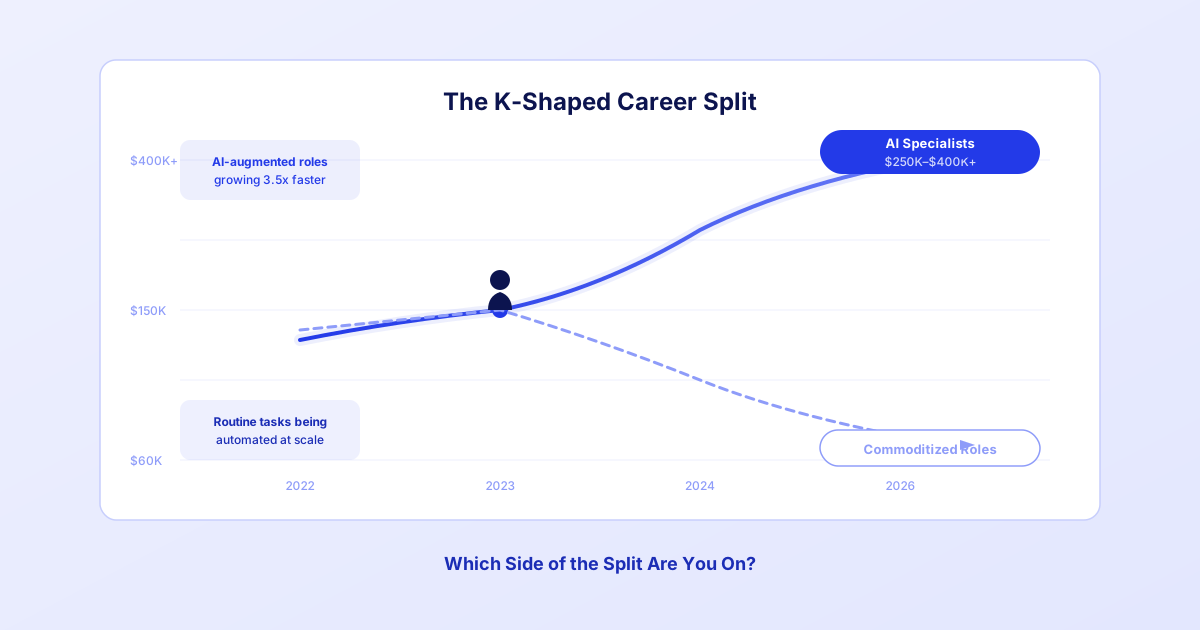
The AI Job Market Is Splitting in Two — Which Side Are You On?
The AI labor market is K-shaped: one side cannot find enough people, the other cannot get callbacks. Learn what's happening and how to position yourself.
Kareeo Team5 min read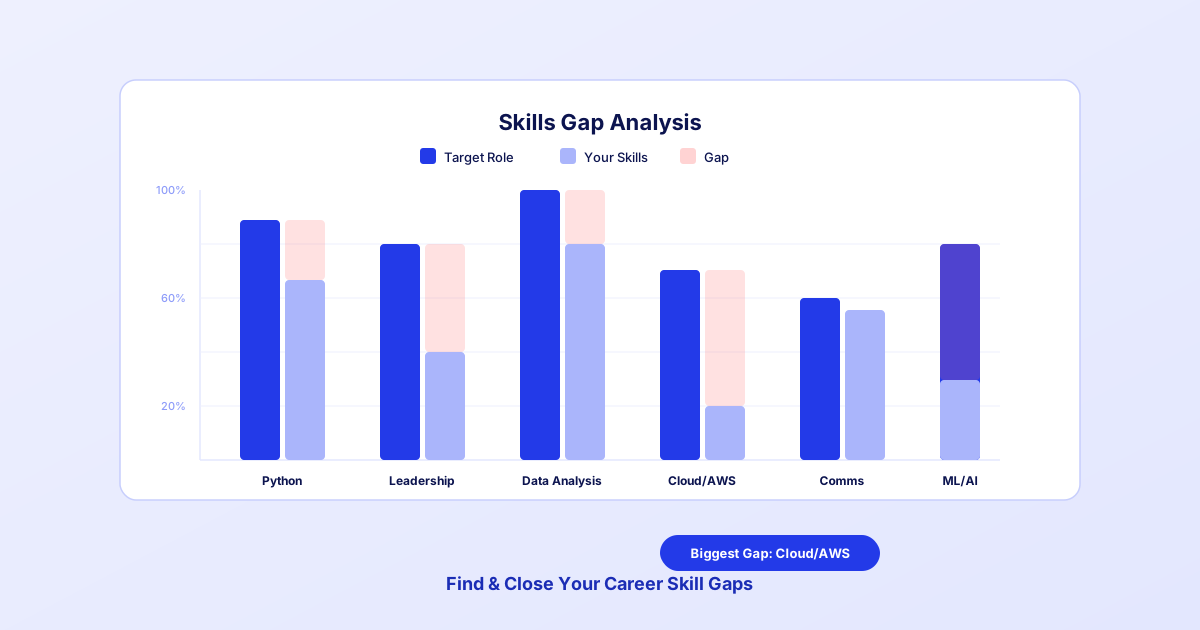
Skill Gap Analysis: How to Find What Your Target Role Needs
A five-step skill gap analysis: define the target role, list what it requires, check what you can prove, and pick the skill gaps worth closing first.
Kareeo Team6 min read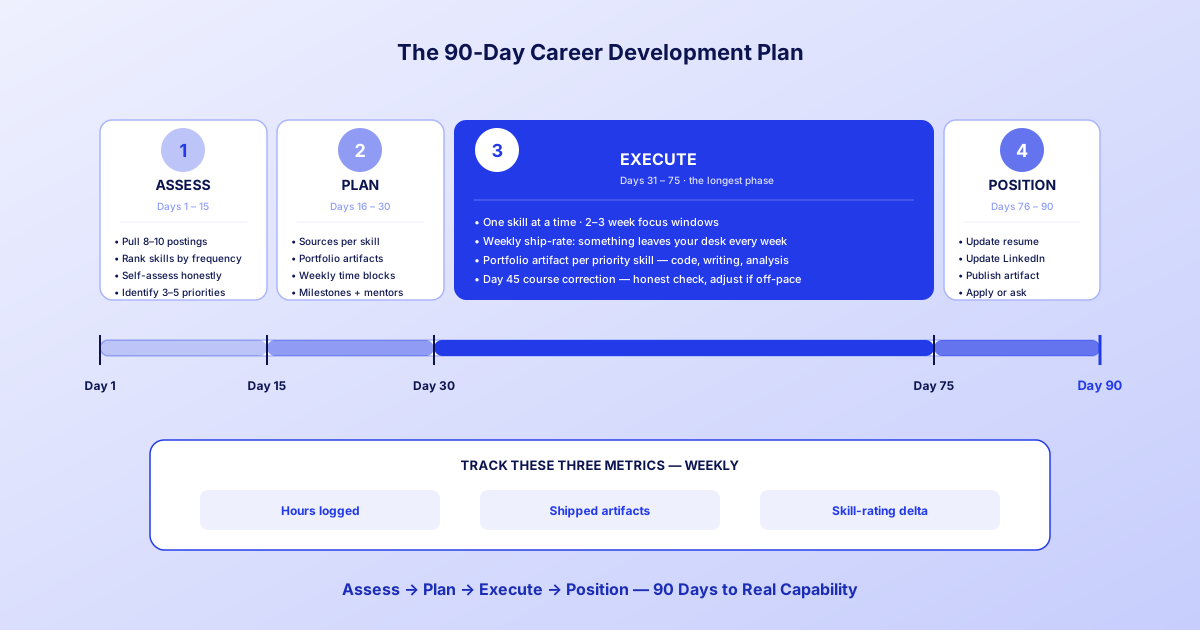
The 90-Day Career Development Plan: A Framework for Getting Promoted, Pivoting, or Leveling Up
Career growth without a plan is drift. Here's the 90-day framework that turns vague career ambition into concrete skill milestones — with templates for each phase.
Kareeo Team10 min read