The AI Job Market Is Splitting in Two — Which Side Are You On?
The AI labor market is K-shaped: one side cannot find enough people, the other cannot get callbacks. Learn what's happening and how to position yourself.

Kareeo Team
Career Content Team · · 5 min read
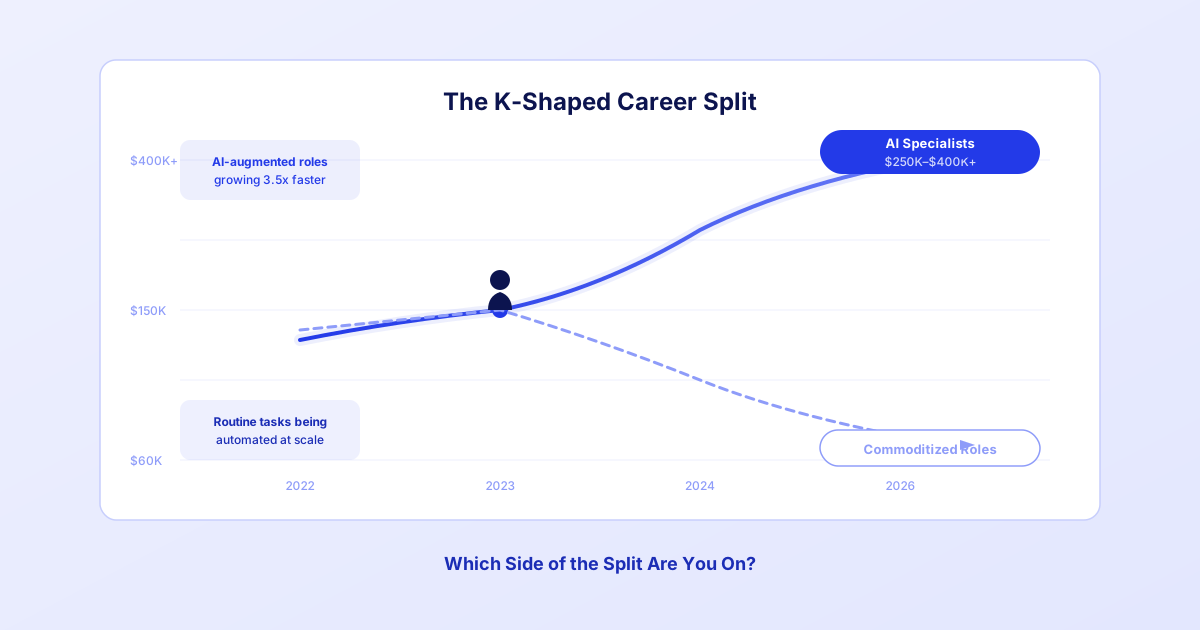
Employers building AI systems say they cannot find enough qualified people. At the same time, experienced professionals in adjacent roles are applying steadily and hearing nothing back. Both things are true at once, and that is what makes this market so disorienting.
What's going on? The AI labor market has split into two completely different worlds. Understanding which one you're in - and how to cross over - could be the most important career decision you make this year.
The K-Shaped Job Market, Explained
The term "K-shaped" comes from economics, and it perfectly describes what's happening in the job market right now. Imagine the letter K: after a shared starting point, two lines diverge — one going up, the other going down.
Market 1 (the declining line): Traditional knowledge work roles. Generalist product managers, standard software engineers, conventional business analysts. Job openings in these categories are flat or falling. Not because these roles are disappearing overnight, but because investment and hiring budgets are flowing elsewhere.
Market 2 (the rising line): Roles that design, build, operate, and manage AI systems. Employers in this category consistently report that openings stay unfilled far longer than the rest of their org chart, and that the applicant pool is thin relative to demand.
The result is a strange asymmetry: roles that are hard to fill sit next to candidates who cannot get a callback.
Why It Feels Impossible (Even If You're Good)
If you've been applying to hundreds of positions and hearing nothing back, you're not imagining things. The problem isn't necessarily your skills — it's the market structure itself.
Here's what's making it worse:
Employers using interviews as learning tools. Some companies that don't fully understand AI are posting roles, collecting resumes, and using interviews to learn from candidates what they actually need. They have no real intention of hiring — they're gathering intelligence.
Keyword mismatch. The skills employers want in Market 2 use specific language that doesn't always appear on traditional resumes. If your resume says "data analysis" but the job posting says "evaluation harness design," the ATS won't connect those dots for you.
Overstated capabilities. On the candidate side, there's inflation too. Being able to chat with ChatGPT is not the same as being able to build, evaluate, and deploy AI systems. The gap between casual AI use and professional AI fluency is wider than most people realize.
Know exactly what to work on next
Add a job you want and Kareeo breaks down the gap between your experience and the role: the skills, keywords, and requirements to close, ranked by what matters most.
See My Gap BreakdownFree to try. No credit card required.
The 7 Skills That Define Market 2
Based on analysis of hundreds of actual AI job postings, seven specific skill sets separate the candidates who can write their own ticket from everyone else:
1. Specification Precision
The ability to communicate intent to AI systems with machine-level clarity. Not "improve customer support" — but precisely defining what the agent should handle, when it should escalate, and how to measure success.
2. Evaluation and Quality Judgment
The single most cited skill across all AI job postings. Can you tell when AI output looks right but isn't? Can you build systems that measure quality at scale?
3. Multi-Agent Decomposition
Breaking complex work into manageable segments that agents can execute. Think of it as project management for AI — but with much tighter specifications than you'd give to humans.
4. Failure Pattern Recognition
AI systems fail in six specific ways: context degradation, specification drift, sycophantic confirmation, tool selection errors, cascading failures, and silent failures. Knowing how to diagnose each one is a premium skill.
5. Trust and Security Design
Where do you draw the line between human and agent? How do you verify an agent only took authorized actions? Understanding cost of error, reversibility, and functional correctness separates senior practitioners from beginners.
6. Context Architecture
Building the information systems that feed agents the right data at the right time. This is the 2026 version of "getting the right documents into the prompt" — but at enterprise scale.
7. Cost and Token Economics
Can you calculate whether an AI solution is worth building? Model selection, blended cost analysis, and ROI projection before committing resources.
The Good News: These Skills Are Learnable
Here's the most important thing about this list: every single one of these skills is learnable. You don't need a computer science degree. You don't need years of engineering experience.
- If you're a technical writer, specification precision is already in your DNA.
- If you're a project manager, multi-agent decomposition maps directly to your work stream planning skills.
- If you're a librarian or information architect, context architecture is essentially the Dewey decimal system for AI agents.
- If you're an editor or auditor, evaluation and quality judgment is what you do every day.
The gap between where you are and Market 2 is probably shorter than you think.
Know exactly what to work on next
Add a job you want and Kareeo breaks down the gap between your experience and the role: the skills, keywords, and requirements to close, ranked by what matters most.
See My Gap BreakdownFree to try. No credit card required.
How to Figure Out Where You Stand
The first step isn't learning a new skill — it's understanding where you are now. Which of these seven capabilities do you already have from your current career? Which ones need development? And what's the fastest path to close those gaps?
This is exactly what career assessment tools are designed for. Understanding your existing strengths gives you a foundation to build from, rather than starting from scratch.
The Bottom Line
The AI job market isn't broken — it's bifurcated. One side is commoditizing fast, competing on volume with diminishing returns. The other side is paying premium rates for skills that are in desperately short supply.
The choice isn't whether to engage with AI. The choice is whether you'll position yourself on the side of the market where employers are short of people - or stay on the side where they are not.
The skills are learnable. The demand is real. The window is now.
Know exactly what to work on next
Add a job you want and Kareeo breaks down the gap between your experience and the role: the skills, keywords, and requirements to close, ranked by what matters most.
See My Gap BreakdownFree to try. No credit card required.
Frequently Asked Questions
- What is the K-shaped AI job market?
- The K-shaped job market describes how AI is creating a divergence in career outcomes. Roles that build and operate AI systems are competing hard for candidates, while roles exposed to automation see fewer openings and slower movement. The two lines are pulling apart rather than converging.
- Which jobs are most at risk from AI automation?
- Roles focused on routine, repetitive tasks are most at risk — including basic data entry, simple content generation, standard customer service, and rules-based analysis. Jobs requiring creativity, complex judgment, relationship building, and AI augmentation are growing.
- How do I future-proof my career against AI disruption?
- Focus on becoming AI-augmented rather than AI-replaced. Learn to use AI tools to multiply your output, develop skills AI can't replicate (leadership, strategy, creativity), and stay current with AI developments in your industry. The goal is to work with AI, not compete against it.
Related Articles
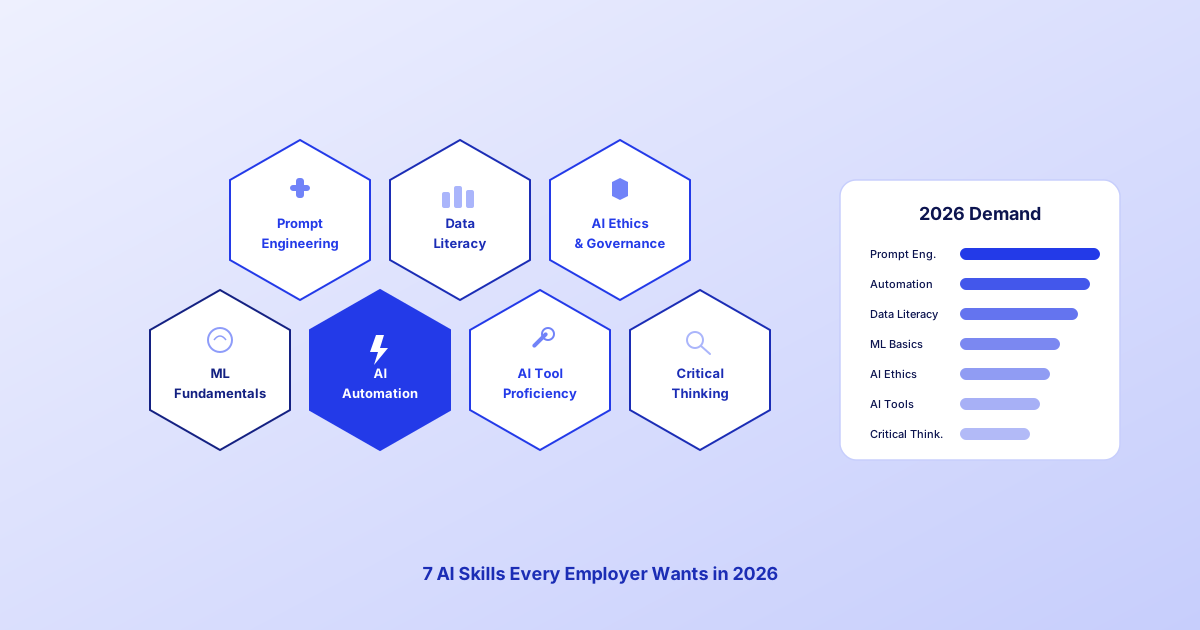
7 AI Skills Every Employer Wants in 2026
These are the 7 skills AI job postings keep asking for, and they're all learnable. Here's what each one means and how to build it.
Kareeo Team8 min read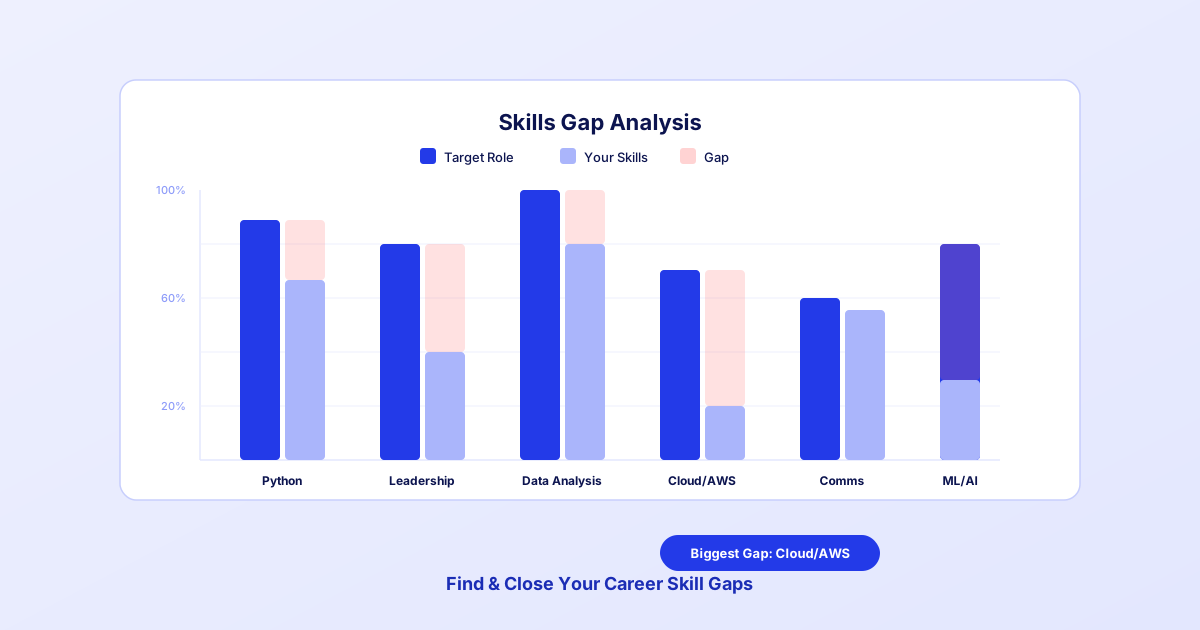
Skill Gap Analysis: How to Find What Your Target Role Needs
A five-step skill gap analysis: define the target role, list what it requires, check what you can prove, and pick the skill gaps worth closing first.
Kareeo Team6 min read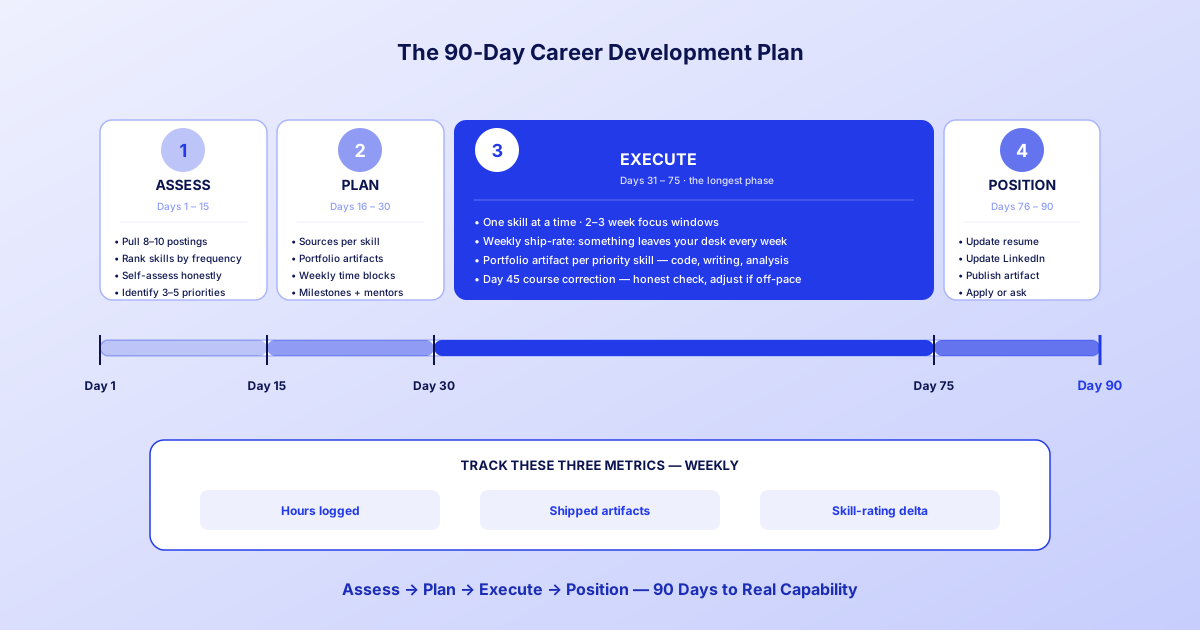
The 90-Day Career Development Plan: A Framework for Getting Promoted, Pivoting, or Leveling Up
Career growth without a plan is drift. Here's the 90-day framework that turns vague career ambition into concrete skill milestones — with templates for each phase.
Kareeo Team10 min read