Skill Gap Analysis: How to Find What Your Target Role Needs
A five-step skill gap analysis: define the target role, list what it requires, check what you can prove, and pick the skill gaps worth closing first.

Kareeo Team
Career Content Team · · 6 min read
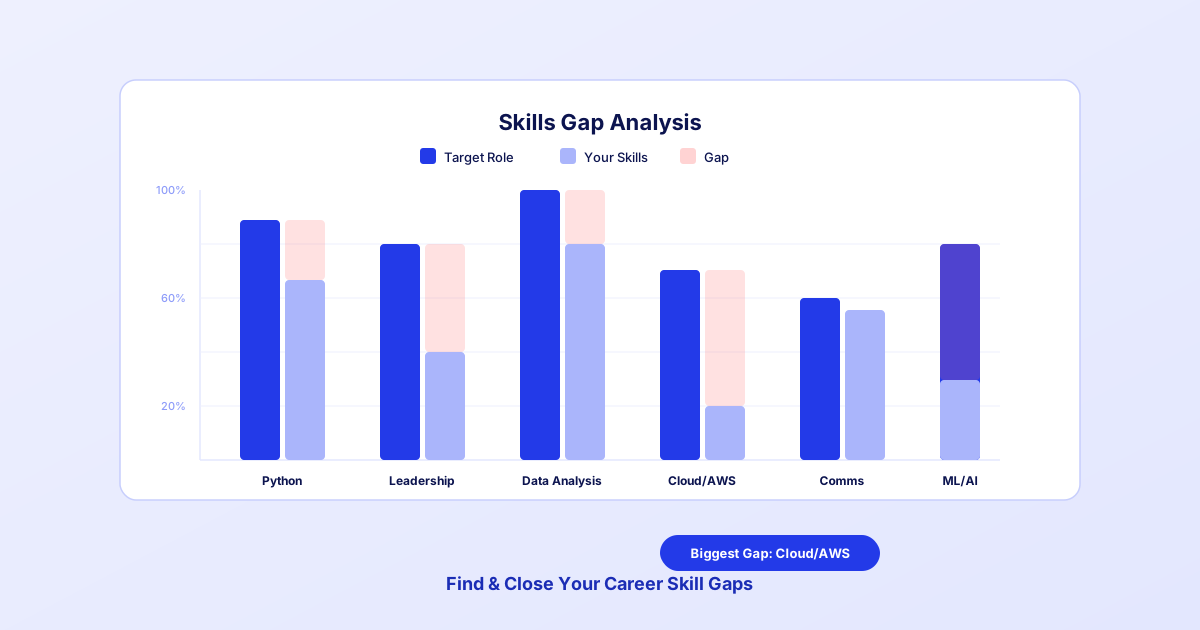
You know you need to grow. You might even know the direction. But when you sit down to figure out exactly which skills to learn, the path gets fuzzy fast.
Should you learn Python or focus on data visualization? Is that project management certification worth the time? Will learning prompt engineering actually help, or is it already commoditized?
The answer depends entirely on where you are now versus where you want to be. And most people are guessing at both.
Why Gut-Feel Gap Analysis Fails
Most career development advice sounds like this: "Learn AI skills." "Get certified." "Upskill." It's well-meaning but useless without specifics.
The problem with gut-feel career planning is threefold:
You overestimate some gaps. You see "machine learning" on a job posting and assume you need a PhD. In reality, the role might need someone who can evaluate ML output — a skill you can build in weeks, not years.
You underestimate others. You've been "managing projects" for years, so you check that box. But the specific skill the market wants is "multi-agent task decomposition" — and that's a fundamentally different capability than managing a human team.
You miss transferable skills entirely. A teacher who wants to move into UX research already has user research skills, group facilitation experience, and curriculum design expertise. They just don't know those count.
The 5-Step Gap Analysis Framework
Here's a systematic approach that replaces guessing with evidence.
Step 1: Define Your Target Role with Precision
"I want to work in AI" isn't specific enough. Pull 5-10 actual job postings for the exact role you want. Copy them into a document.
Look for the job postings that make you think "I could see myself doing this in 12 months." Those are your targets.
Step 2: Extract the Required Skills
Go through every posting and list every skill mentioned. Include:
- Hard skills (tools, technologies, methodologies)
- Soft skills (communication style, collaboration model)
- Domain knowledge (industry expertise, regulatory understanding)
- Experience requirements (years, project types, team sizes)
Combine duplicates and rank by frequency. If 8 out of 10 postings mention "evaluation frameworks," that's a core requirement.
Know exactly what to work on next
Add a job you want and Kareeo breaks down the gap between your experience and the role: the skills, keywords, and requirements to close, ranked by what matters most.
See My Gap BreakdownFree to try. No credit card required.
Step 3: Honestly Assess Your Current State
For each skill on your list, rate yourself:
- Strong: You could demonstrate this in an interview with specific examples
- Developing: You have some experience but couldn't lead with it
- Gap: You don't have meaningful experience here
- Transferable: You have a related skill from a different context
Be honest. The goal isn't to feel good — it's to see clearly.
Step 4: Identify the Highest-Impact Gaps
Not all gaps are equal. Prioritize based on:
- Frequency: How many postings require it? (Higher = more critical)
- Difficulty: How long would it take to develop? (Lower = faster win)
- Leverage: Does closing this gap unlock other opportunities? (Higher = more valuable)
The sweet spot is high-frequency, moderate-difficulty, high-leverage gaps. These are your first targets.
Step 5: Build a 90-Day Learning Plan
For each priority gap, identify:
- The specific learning resource (course, project, certification)
- A measurable milestone ("complete X" or "build Y")
- A timeline (when you'll achieve it)
- A portfolio artifact (something you can show an interviewer)
90 days is the right horizon. Long enough to build real skills, short enough to maintain urgency.
The Silent Failure Problem in Self-Assessment
Here's where gap analysis gets tricky — and where AI actually helps.
One of the most common failure patterns in AI systems is called "silent failure." The output looks correct on the surface, but something is wrong underneath. The same thing happens with self-assessment.
You might think your resume demonstrates "stakeholder management" because you worked with clients. But an objective analysis of your resume against a specific job posting might reveal that you never used that exact phrase, never quantified the scope, and didn't frame the experience in terms the ATS recognizes.
The gap isn't in your skills — it's in how your skills are presented. That's a different problem, and it requires a different solution.
Know exactly what to work on next
Add a job you want and Kareeo breaks down the gap between your experience and the role: the skills, keywords, and requirements to close, ranked by what matters most.
See My Gap BreakdownFree to try. No credit card required.
The Seniority Trap
Senior professionals — directors, VPs, principals — fall into a unique gap analysis trap. They have decades of experience, but job postings still list basic skills alongside advanced ones.
Does a VP of Engineering need to list "Python" on their resume? Maybe not for the human reader. But for the ATS and the initial screen, the absence of expected technical keywords can create false negatives.
The fix isn't padding your resume with basic skills. It's understanding what the automated systems expect and making sure your seniority is clear while still meeting keyword requirements.
Transferable Skills Are Your Secret Weapon
The biggest gap analysis mistake is treating career transitions as starting from zero. Almost every skill transfers — it just needs translation.
| Current Role | Transferable Skill | AI-Era Application |
|---|---|---|
| Teacher | Curriculum design, needs assessment | Context architecture, user research |
| Librarian | Information architecture, cataloging | Context architecture for AI agents |
| Lawyer | Specification writing, edge case analysis | Specification precision, trust design |
| Editor | Quality evaluation, error detection | AI output evaluation, quality judgment |
| Project Manager | Task decomposition, delegation | Multi-agent orchestration |
| Financial Analyst | Cost modeling, ROI analysis | Token economics, cost optimization |
Your existing skills aren't obsolete. They're the foundation. The question is which bridge to build from where you are to where you want to be.
Your Next Step
Stop guessing what's missing. Get a data-driven view of exactly where your experience matches your target role — and where the gaps are. A specific, quantified gap analysis turns "I should probably learn something" into "Here are the three skills that will move me forward fastest."
The gap between where you are and where you want to be is usually smaller than it looks. But you have to measure it first.
Know exactly what to work on next
Add a job you want and Kareeo breaks down the gap between your experience and the role: the skills, keywords, and requirements to close, ranked by what matters most.
See My Gap BreakdownFree to try. No credit card required.
Frequently Asked Questions
- What is a career skill gap analysis?
- A skill gap analysis compares your current skills and experience against the requirements of your target role. It identifies specific areas where you need to develop — whether technical skills, certifications, or soft skills — so you can focus your learning efficiently.
- How do I identify my skill gaps for a career change?
- Start by analyzing 5-10 job postings for your target role. List every required and preferred skill, then honestly rate your proficiency in each. AI tools like Kareeo can automate this by comparing your resume against job requirements and highlighting exact gaps.
- How long does it take to close a career skill gap?
- It depends on the gap. Learning a new tool is a short exercise. Picking up a new programming language or working through a certification is a longer one. Moving into an entirely new domain is longer still. Anyone quoting you a fixed timeline is guessing, because it depends on the hours you can give it and what you already bring.
Related Articles
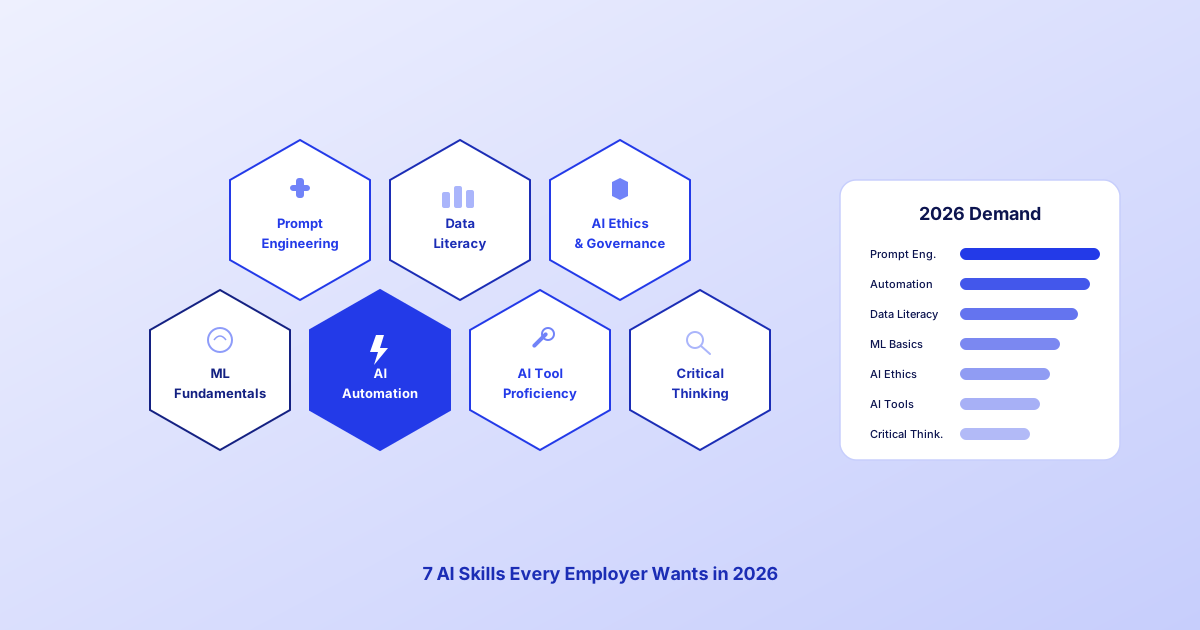
7 AI Skills Every Employer Wants in 2026
These are the 7 skills AI job postings keep asking for, and they're all learnable. Here's what each one means and how to build it.
Kareeo Team8 min read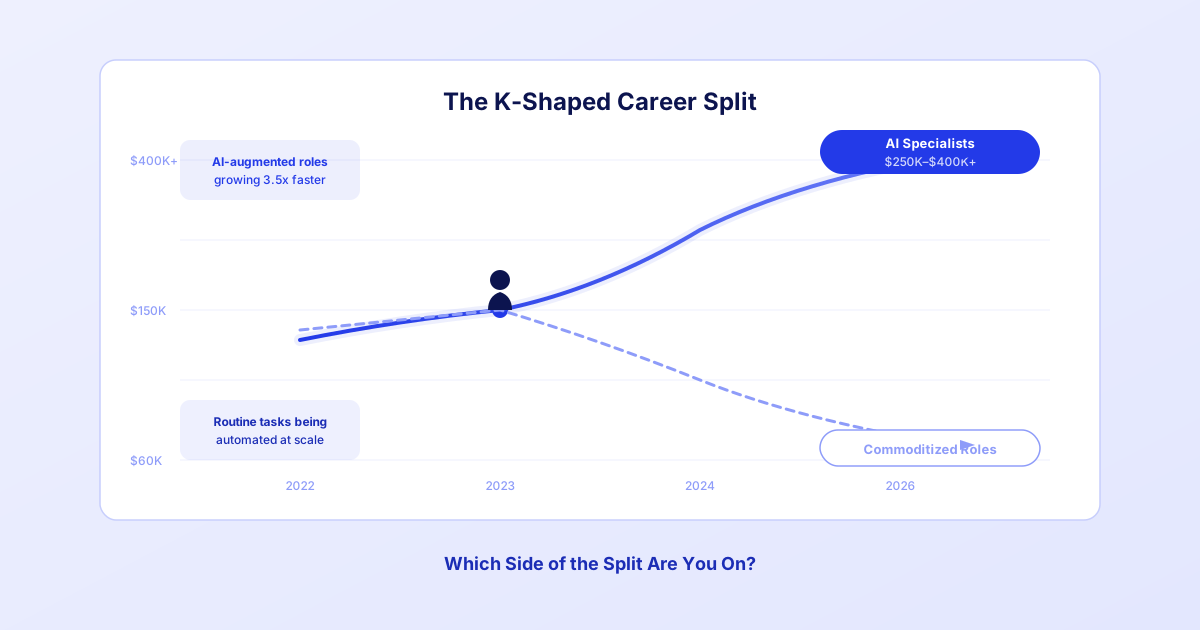
The AI Job Market Is Splitting in Two — Which Side Are You On?
The AI labor market is K-shaped: one side cannot find enough people, the other cannot get callbacks. Learn what's happening and how to position yourself.
Kareeo Team5 min read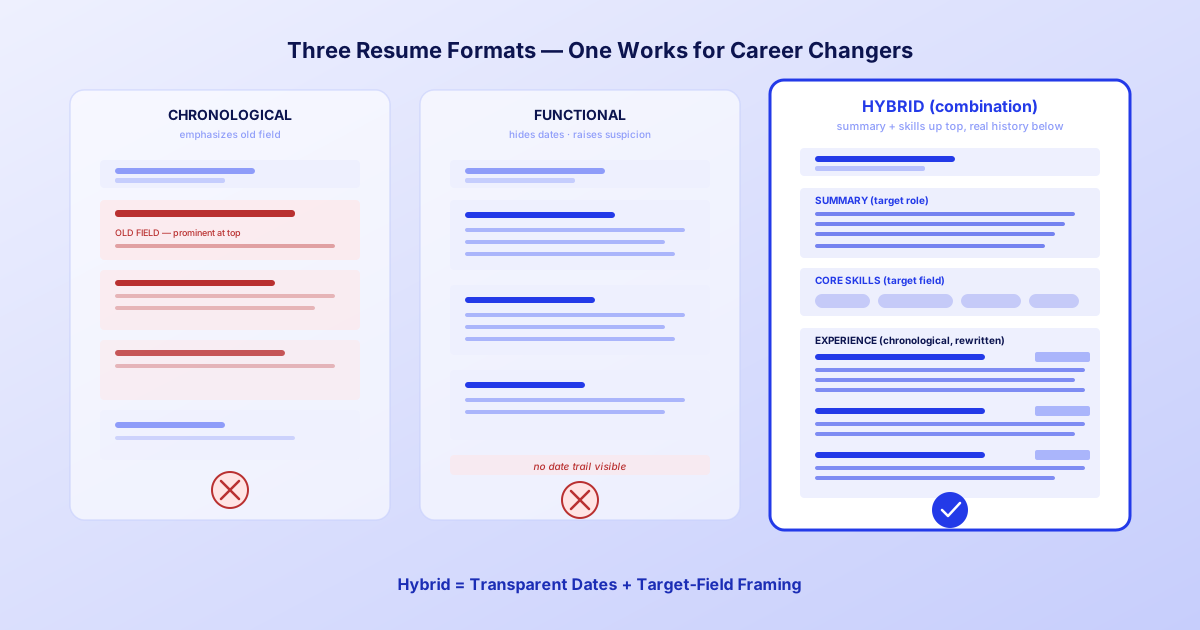
The Best Resume Format for Career Changers in 2026 (With Templates)
Functional resumes look like hiding. Chronological resumes emphasize the wrong thing. Here's the hybrid format that actually works for career changers — plus transferable-skill templates by transition type.
Kareeo Team9 min read