A 30-Day Interview Practice Protocol: Build Structure Under Pressure
A 30-day interview practice protocol that builds confidence, structure, and response quality. Here's the exact process, week by week.

Kareeo Team
Career Content Team · · 7 min read
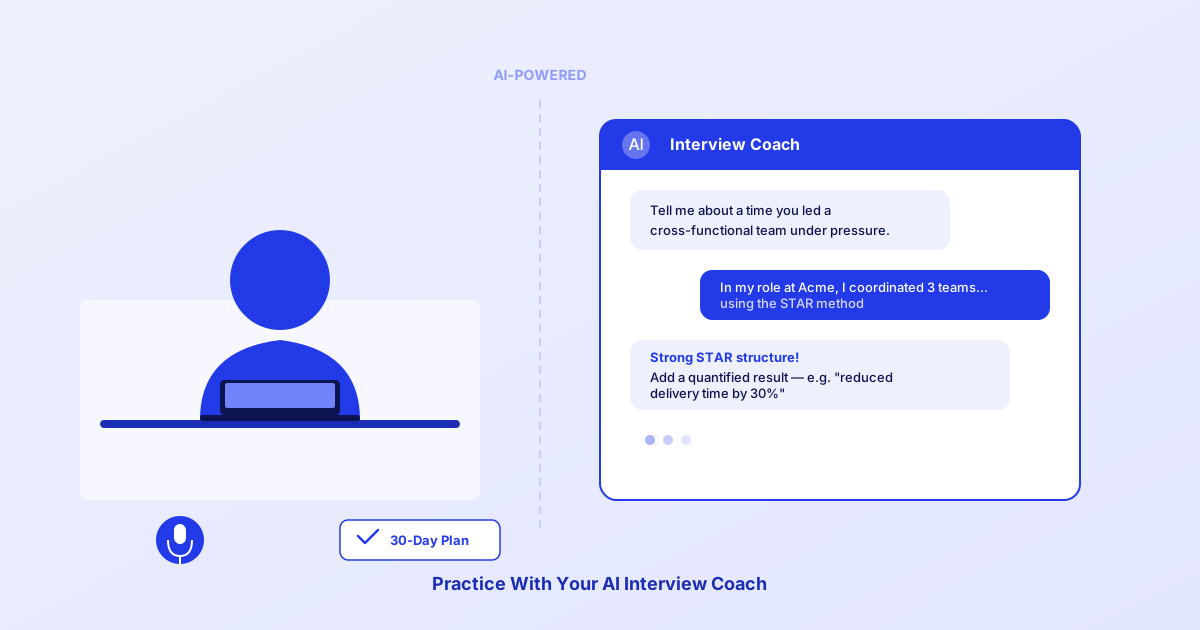
Plenty of capable people freeze during interviews. Not because they don't know the answers - because they can't organize their thoughts fast enough under pressure. The interviewer asks a behavioral question, and the brain goes blank for three seconds that feel like thirty.
The fix is not talent. It's structured, repeated practice. This is a 30-day interview practice protocol you can run on your own: one focused session per day, 15-20 minutes each. Here's how to structure it, week by week.
Week 1: The Humbling Baseline
Days 1-7: See how unprepared "prepared" really is.
Most people think they are decent at interviews. They have read about the STAR method. They know to research the company. They have a few good stories ready.
Then a question lands like: "Tell me about a time you had to make a decision with incomplete information." Record your answer and play it back. If you are like most people, you rambled for four minutes, jumped between three different stories, and never landed on a clear result.
That gap is normal, and a real interviewer rarely points it out directly. That is exactly why self-review, a candid practice partner, or an AI practice tool matters in week one - something has to reflect the weakness back to you.
Key learning from Week 1: The gap between "knowing the STAR method" and "using the STAR method under pressure" is enormous. Reading about structure doesn't build structure. Practice does.
Week 2: Building the Response Framework
Days 8-14: Develop muscle memory for structured responses.
In the second week, stop trying to be impressive and focus on being organized. Run every response through the same skeleton:
- Situation - One sentence. Set the scene. Include scope (team size, stakes, timeline).
- Task - One sentence. What was specifically your responsibility?
- Action - Two to three sentences. What did you do? Be specific about your decisions, not team outcomes.
- Result - One to two sentences. Quantify whenever possible. What changed because of your action?
Have a practice partner or an AI practice tool throw different question types at you - behavioral, situational, technical, and curveballs. Each time, practice slotting your response into that skeleton.
By around day 14, something clicks. The structure becomes automatic. You no longer have to think about format, so you can focus entirely on content.
Analyze every job against your resume
Add any job and Kareeo scores your compatibility, surfaces gaps and knockout requirements, and tailors your resume — all tracked through one pipeline.
Analyze a JobFree to try. No credit card required.
Week 3: Sharpening Edge Cases
Days 15-21: Handle the questions that actually trip people up.
The standard behavioral questions - "Tell me about a challenge" or "Describe a time you led a team" - get easier fast. Week 3 is when the real practice starts.
Drill the questions that carry hidden traps:
- "Why did you leave your last role?" (How to be honest without being negative)
- "What's your biggest weakness?" (How to be genuine without sabotaging yourself)
- "Where do you see yourself in 5 years?" (How to show ambition without sounding like you'll leave)
- "Tell me about a time you failed." (How to own it without dwelling)
These questions aren't really about the answer. They're about your judgment, self-awareness, and communication skills. Practicing them repeatedly - ideally with feedback from a practice partner or an AI practice tool - turns rambling responses into confident ones.
Key learning from Week 3: The hardest interview questions have well-structured answers that feel natural once you've practiced them enough. "Natural" doesn't mean unscripted - it means so well-practiced that the structure disappears.
Week 4: The Evaluation Mindset
Days 22-30: Learn to evaluate your own responses.
The most valuable skill this protocol builds isn't answering questions better. It's learning to evaluate your own answers in real time.
This maps directly to what AI professionals call "evaluation and quality judgment" - one of the most in-demand skills in the AI job market. The principle is the same: don't accept output just because it sounds fluent. Check whether it's actually correct and complete.
After each practice session, review your responses through these lenses:
- Did I answer the actual question asked? (Not a related question I preferred)
- Was my STAR structure clear? (Could someone summarize each element?)
- Did I quantify results? ("Improved by 30%" vs. "things got better")
- Did I stay under 2 minutes? (Long answers lose interviewers)
- Did I show my specific contribution? ("I decided" vs. "we decided")
This self-evaluation habit turns you from someone who practices interviews into someone who coaches themselves through them.
Analyze every job against your resume
Add any job and Kareeo scores your compatibility, surfaces gaps and knockout requirements, and tailors your resume — all tracked through one pipeline.
Analyze a JobFree to try. No credit card required.
What Changes After 30 Days
If you run the protocol consistently, the changes are about process, not luck:
Faster starts. The goal is to stop freezing when a question lands. Once the structure is automatic, your brain immediately starts selecting the right story instead of stalling.
Tighter answers. Aim to bring long, wandering responses down to roughly 90 seconds to two minutes. Every sentence should earn its place.
Steadier delivery. Repetition replaces anxiety with familiarity. You are not becoming a different person - you are practicing until competence feels natural.
None of this promises a specific result in any real interview. Hiring depends on many factors outside your control. What structured practice does reliably change is how prepared and organized you are when you walk in.
Why AI Practice Differs from Human Practice
Practicing with a friend is far better than not practicing at all. But third-party AI practice tools have three structural advantages worth knowing about:
No social cost. You can give a terrible answer and try again immediately. There's no awkwardness, no judgment, no need to save face, so you practice more honestly.
Instant, specific feedback. The better tools don't just say "that was good" - they flag things like a missing measurable result or an unclear statement of your role. Feedback that tells you exactly what to fix beats vague encouragement.
Unlimited reps. A friend will do 2-3 practice questions before they tire out. A tool will do 50. Repetition is where skill lives.
Use whichever fits your situation. The protocol works with a human partner, a practice tool, or a mix of both.
The Practice Protocol
If you want to replicate this 30-day plan, here's the schedule:
Days 1-7: One 15-minute session per day. Focus on basic STAR structure. Don't worry about being impressive - focus on being organized.
Days 8-14: Increase to 20 minutes. Practice different question types (behavioral, situational, "tell me about yourself"). Start timing your responses - aim for under 2 minutes.
Days 15-21: Focus on the hard questions. Weaknesses, failures, career gaps, salary expectations. Practice until these feel as natural as your strength stories.
Days 22-30: Full-length practice runs. 30-minute sessions that simulate a real interview end to end. Practice your opening, your questions for the interviewer, and your closing statement.
Your Next Step
Interview anxiety isn't a personality trait. It's a practice gap. And practice gaps have a straightforward solution: practice.
Start one practice session today. Just 15 minutes of structured behavioral questions, answered out loud and reviewed against the STAR lenses above. After a week, you'll already feel the difference.
If you want practice that matches a specific role, generate an interview prep playbook from the job description first, so the questions you drill reflect the responsibilities and requirements that employer actually lists. Practice tied to the real job beats generic rehearsal every time.
The people who walk in prepared aren't necessarily more qualified than everyone else. They've practiced organizing their thinking under pressure - and that's a choice you can make right now.
Analyze every job against your resume
Add any job and Kareeo scores your compatibility, surfaces gaps and knockout requirements, and tailors your resume — all tracked through one pipeline.
Analyze a JobFree to try. No credit card required.
Frequently Asked Questions
- Can AI really help you prepare for job interviews?
- Yes. AI can generate likely behavioral and technical questions for a specific role, help you rehearse structured answers using frameworks like the STAR method, and let you repeat that practice as many times as you need. The value comes from structure and repetition rather than any single session - practicing the same answer types under time pressure builds the muscle memory to organize your thoughts quickly.
- What is the STAR method for interviews?
- STAR stands for Situation, Task, Action, Result. It's a framework for structuring behavioral interview answers by describing a specific situation, the task you faced, the action you took, and the quantified result you achieved.
- How much interview prep should I do before a real interview?
- Focus on quality and repetition rather than a fixed number of sessions. Practicing behavioral questions, role-specific scenarios, and company topics across several short sessions over two to four weeks tends to beat cramming. Prep sessions anchored to the specific job description - the actual responsibilities and requirements - give you the most relevant practice.
Related Articles
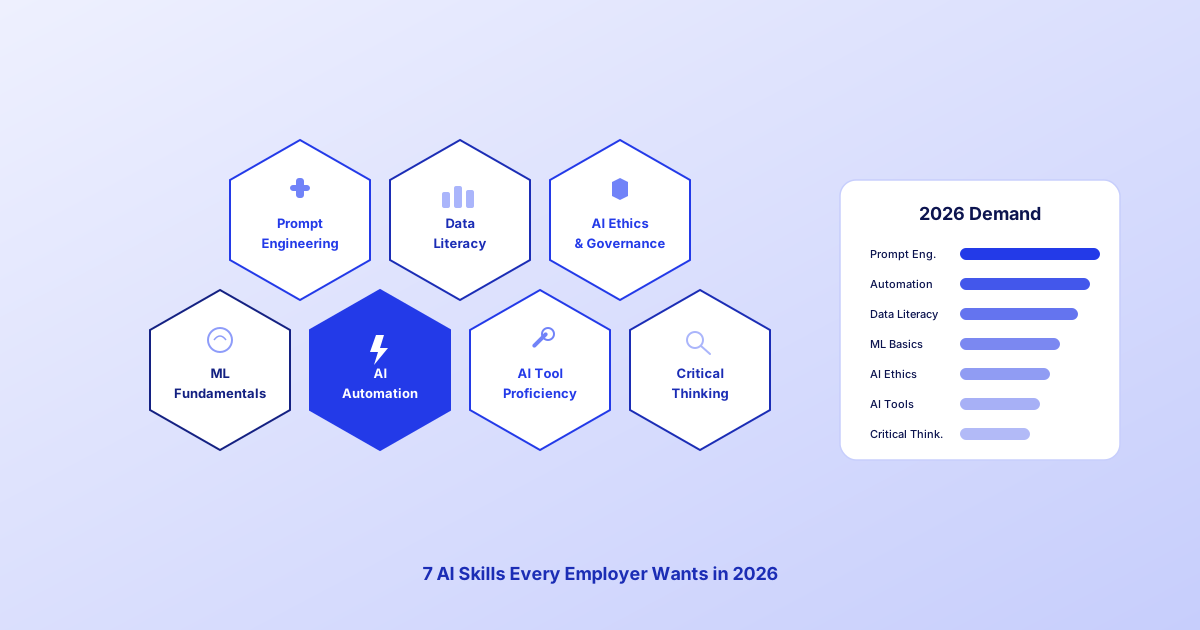
7 AI Skills Every Employer Wants in 2026
These are the 7 skills AI job postings keep asking for, and they're all learnable. Here's what each one means and how to build it.
Kareeo Team8 min read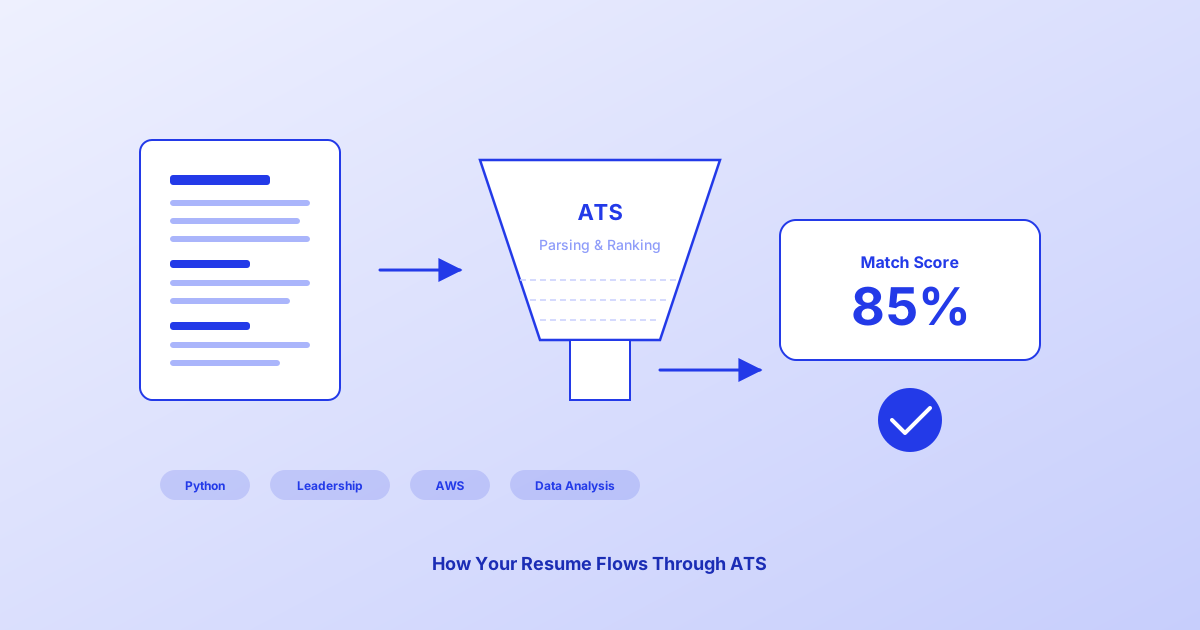
How to Pass the ATS in 2026: Getting Your Resume Through the Software Screen
Most mid-size and large companies screen resumes with software before a person reads them. Learn exactly how an ATS works and the fixes that make your resume hold up to it.
Kareeo Team6 min read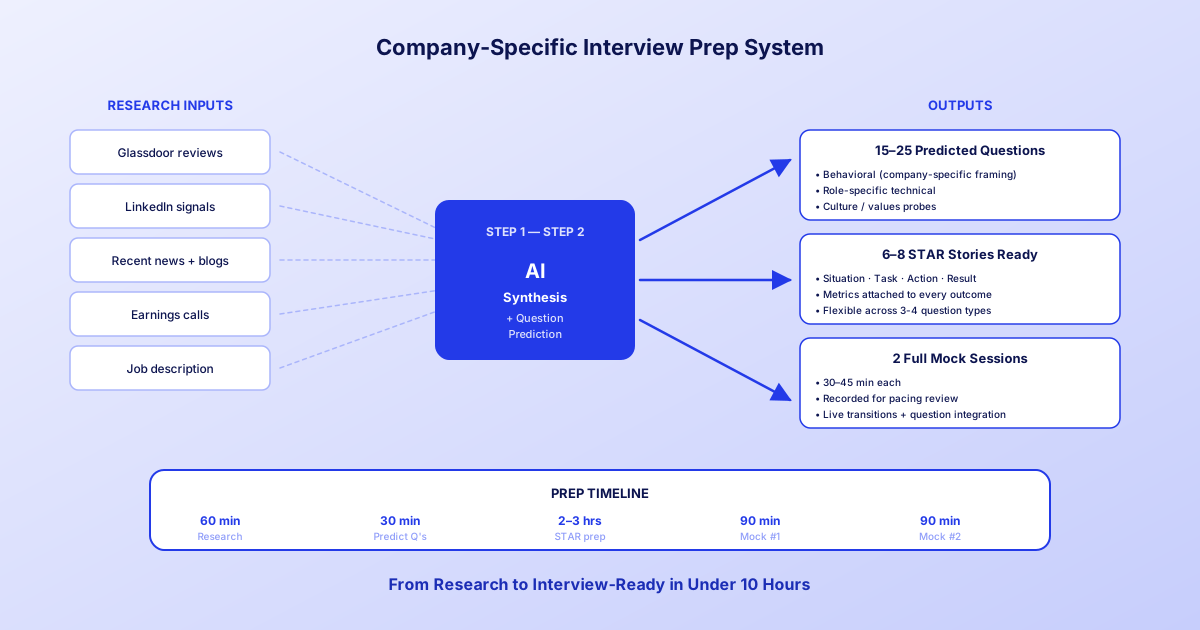
How to Prepare for Any Company's Interview Using AI: A Step-by-Step System
Generic interview prep is dead. Here's the AI-powered system for reverse-engineering any company's interview process, anticipating the likely questions, and walking in prepared.
Kareeo Team8 min read