How to Prepare for Any Company's Interview Using AI: A Step-by-Step System
Generic interview prep is dead. Here's the AI-powered system for reverse-engineering any company's interview process, anticipating the likely questions, and walking in prepared.

Kareeo Team
Career Content Team · · 8 min read
You've done it before. You spent hours researching a company, read their About page, skimmed three Glassdoor reviews, and walked into the interview thinking you were prepared. Then the interviewer asked something specific - about a recent product launch, a leadership transition, a specific framework they use - and you froze.
The problem wasn't effort. It was method. Generic interview prep prepares you for generic interviews. Company-specific prep prepares you for the actual interview you're walking into. And in 2026, AI makes company-specific prep fast enough to do for every real opportunity.
This post covers the full system: research, question prediction, practice, and day-of ritual.
Why Generic Prep Fails
Most interview prep advice treats companies as interchangeable. The same "tell me about yourself" answer. The same STAR-method bullets. The same three questions to ask at the end.
That's fine for the phone screen. It fails everywhere else. Here's why:
Every company has interview DNA. Amazon's Leadership Principles. Google's structured behavioral framework. A startup's obsession with ownership and speed. A consulting firm's case-interview rigor. Generic answers don't land in company-specific frameworks.
Interviewers ask about recent news. A company in the middle of a product transition, an IPO, or a layoff will test whether you know. Candidates who've read last week's press show up differently.
Team-level context matters. The interviewer is a specific person with a specific role. They care about specific things. Research into your actual panel members changes what you emphasize.
AI-powered prep doesn't replace thought. It compresses the research phase so you can spend time on the thinking phase.
The 5-Phase System
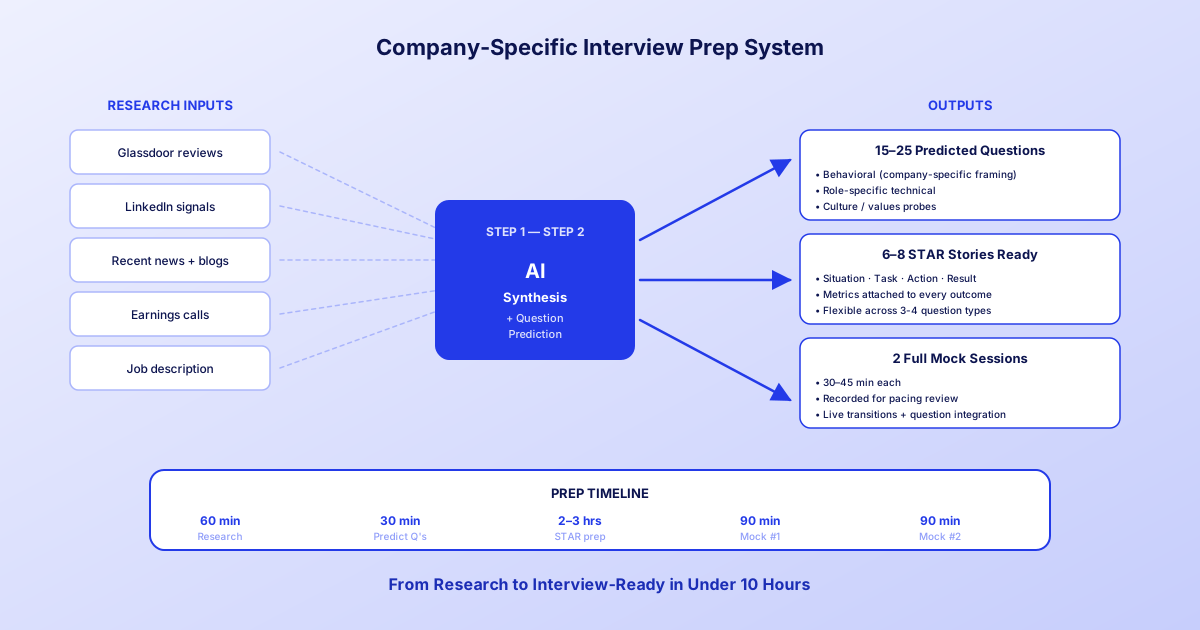
Phase 1: Research (60 minutes, AI-assisted)
Gather raw material about the company, role, and interviewers. Use AI to synthesize.
Data sources to pull:
- Company website: About page, product pages, recent blog posts, careers page.
- Glassdoor: Last 20-30 interview reviews for the specific role level.
- LinkedIn: Leadership team profiles. Recent posts from your interviewers if accessible. Employees at the company level you're interviewing for.
- Recent news: Search Google News for the company name + last 6 months. Look for product launches, leadership changes, funding rounds, layoffs, partnerships.
- If public: Most recent earnings call transcript, investor presentation.
- Company culture: Any Blind threads, Reddit discussions, or Teamblind conversations about the role.
AI synthesis prompt:
I'm interviewing for a [Role] at [Company]. Based on the following research [paste what you collected], help me identify: (1) the company's current strategic priorities, (2) signals about interview style and questions, (3) the 3-5 topics I'll likely be tested on for this role, and (4) any risks or concerns I should be ready to address.
Save the output as your prep notes.
Phase 2: Predict the Questions (30 minutes)
With the research synthesized, generate a predicted question list. Use AI to do this systematically.
AI question-prediction prompt:
Given this company research [paste], this job description [paste], and this role level, generate a predicted interview question list broken into: behavioral (expected company-specific framing), role-specific technical or domain, culture/values probe, and stretch questions. For each, provide the likely phrasing, what the interviewer is actually assessing, and a structure for an ideal answer.
Expect 15-25 predicted questions. Most will be directionally correct even if the exact wording differs.
Phase 3: Prepare STAR Answers (2-3 hours)
For behavioral questions, build a bank of 6-8 STAR stories from your past experience. These aren't memorized scripts - they're structured anecdotes you can deploy flexibly.
Each STAR story should cover:
- Situation: Context in 1-2 sentences.
- Task: What you specifically needed to do.
- Action: What you did, in 2-3 specific steps.
- Result: Outcome with a metric.
Six good stories cover most behavioral questions. Each story can be angled for multiple prompts - your "led a cross-functional launch" story answers questions about leadership, collaboration, pressure, and ambiguity.
Know exactly what to work on next
Add a job you want and Kareeo breaks down the gap between your experience and the role: the skills, keywords, and requirements to close, ranked by what matters most.
See My Gap BreakdownFree to try. No credit card required.
Phase 4: Practice Out Loud
Static question lists aren't practice. Active practice means simulating the interview with real-time pressure - out loud, on the clock, with someone or something pushing back.
Effective practice setup:
- Recruit a friend to play interviewer, or use a third-party interview-practice tool, with your predicted question list as the script.
- Do a full 30-45 minute session.
- Record yourself if possible.
- Focus on transitions (how you move from question to question) and answer length (target 60-90 seconds per behavioral).
What to evaluate:
- Answer structure (did you use STAR?)
- Pacing (too fast is anxiety; too slow is stalling)
- Specificity (did you name actual projects, metrics, companies?)
- Question integration (did you answer what was asked, not what you wish was asked?)
Two full practice sessions for a critical interview is appropriate. More than three is usually diminishing returns.
Phase 5: Day-Of Ritual (90 minutes before the interview)
Day-of should be light, not heavy. No new research. No new content.
90 minutes before:
- Re-read your prep notes once.
- Review your STAR stories as a list.
- Re-read your predicted question list and top 3 answers.
30 minutes before:
- Calming ritual: walk, breathe, music - whatever settles your nerves.
- Logistics check: link, camera, lighting, water.
5 minutes before:
- Open the interview context in a new tab.
- Final re-read of the job description.
- Power posture for 2 minutes.
Go in.
Company-Style Interview Frameworks to Know
Some companies have well-known interview frameworks. If you're interviewing at one, prep specifically against their framework:
Amazon - Leadership Principles (16 principles). Behavioral questions will map to these. Know which 4-5 you'll anchor your stories to.
Google - Structured behavioral (Googleyness + Leadership) + general cognitive ability. Expect rigorous role-play scenarios.
Meta - Behavioral (past experience) + coding/design (technical roles) + product sense (PM roles). Culture questions often probe "move fast" and ownership.
Consulting (MBB) - Case interview framework. Multiple rounds of structured problem-solving.
Early-stage startups - Less structured but high stakes. Expect founder-level questions: "why this role, why this company, why now?"
Big enterprise (Oracle, IBM, etc.) - Traditional behavioral + technical. Expect more hierarchical interview formats.
Frameworks aren't barriers - they're hints. A company with a published framework is telling you exactly how to prepare.
Questions to Ask the Interviewer
Good questions demonstrate preparation. Generic questions ("what's the culture like?") signal the opposite.
Use the research to generate specific questions:
- "I saw the company announced [specific product launch] in Q1. How is that shaping team priorities this year?"
- "I noticed on LinkedIn you recently [specific role change / project]. How did that shape how you see this role?"
- "Glassdoor mentions [specific interview dimension]. Can you walk me through how you evaluate that in candidates?"
Three company-specific questions ready per round. You'll rarely use all three - but the interviewer will notice you came prepared.
Handling Questions You Didn't Predict
No prep is perfect. You'll get questions you didn't anticipate. The framework for those:
Pause. Three seconds of silence is fine. It signals thought, not freeze.
Clarify if ambiguous. "Just to make sure I answer the right question - are you asking about [X] or [Y]?"
Structure on the fly. "There are a few ways I could answer that. Let me give you [specific angle]."
Use STAR even if unrehearsed. The structure holds even with content you're recalling in the moment.
Don't fake specifics. If you don't know something, say so. "I don't have direct experience with [X], but here's how I'd approach it..."
Know exactly what to work on next
Add a job you want and Kareeo breaks down the gap between your experience and the role: the skills, keywords, and requirements to close, ranked by what matters most.
See My Gap BreakdownFree to try. No credit card required.
When to Skip Deep Prep
Not every interview deserves 15 hours.
Light prep (2-3 hours): Early-stage screens. Roles you're lukewarm on. Backup companies in a multi-offer search.
Medium prep (5-8 hours): Real target roles. Companies you'd actively consider.
Heavy prep (10-15+ hours): Dream jobs. Final-round interviews at companies you'd say yes to. Roles where the comp delta over your current job is significant.
Budget prep time by the stakes. Don't over-prep a job you'll walk away from anyway.
Signals That You're Actually Prepared
You know you're prepared when:
- You can explain the company's business in three sentences without notes.
- You've named the three most likely interview questions and have 60-second answers ready.
- You have two company-specific questions ready to ask.
- You can describe each interviewer's role and why they're on your panel.
- You've done at least one full practice run without the script.
If you can't do all five, you have more prep to do.
Your Next Step
Pick your next scheduled interview. Block 2 hours this week for Phase 1 (research) and Phase 2 (question prediction). Use an AI assistant to compress what would have been 6 hours of research into 90 minutes of synthesis.
Then pick 6 STAR stories from your past and write them out. Don't memorize them - structure them. Make sure each one has real metrics.
The difference between a good interview and a great one usually isn't talent. It's the 10 hours of specific prep that made every answer sound like you'd been thinking about this company for weeks.
Know exactly what to work on next
Add a job you want and Kareeo breaks down the gap between your experience and the role: the skills, keywords, and requirements to close, ranked by what matters most.
See My Gap BreakdownFree to try. No credit card required.
Frequently Asked Questions
- How do I research a company's interview process?
- Combine three sources: Glassdoor interview reviews (for question patterns and process structure), LinkedIn employee posts (for culture signals and recent priorities), and the company's own content - blog posts, earnings calls, and leadership interviews. Feed all three into an AI assistant and ask it to synthesize likely interview topics for your specific role.
- Can AI predict the actual interview questions I'll get?
- AI can surface the likely topics and question types by combining the job description with company research. It can't predict the exact wording, but topic-level preparation is where the value is. The point is rehearsing your answer structure, not memorizing specific questions.
- How much time should I spend on interview prep?
- For a dream job: 10-15 hours distributed over 1-2 weeks. For a standard role: 4-6 hours over 3-5 days. Day-of prep should be light (re-reading your notes, calming ritual), not heavy research. The AI-powered process compresses this timeline because company research becomes minutes instead of hours.
Related Articles
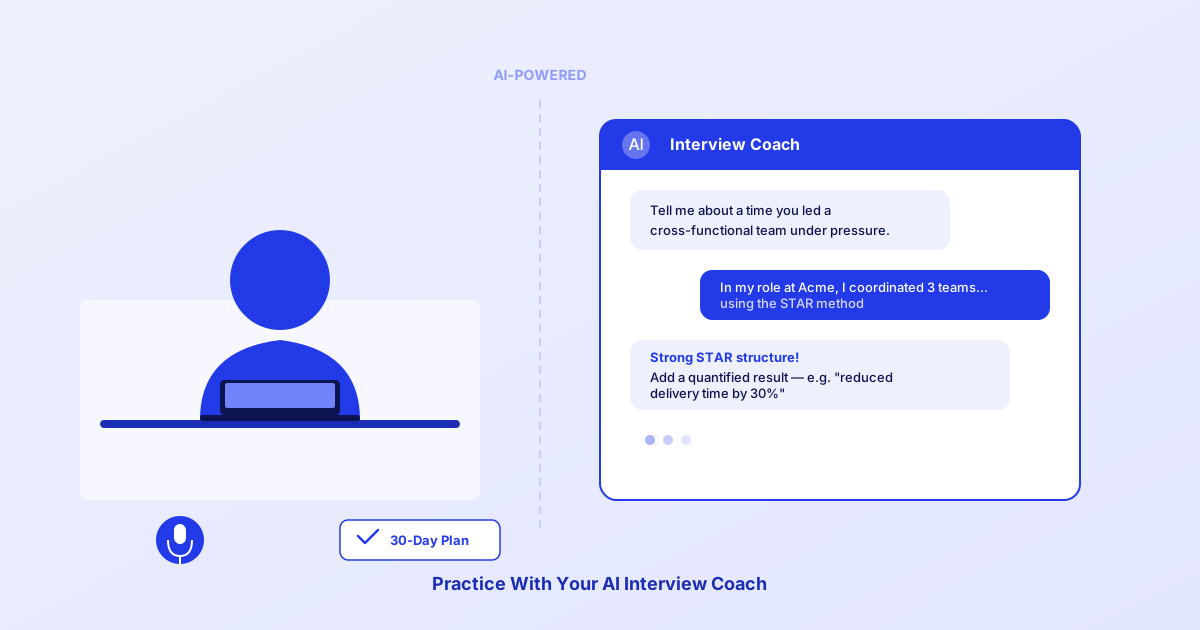
A 30-Day Interview Practice Protocol: Build Structure Under Pressure
A 30-day interview practice protocol that builds confidence, structure, and response quality. Here's the exact process, week by week.
Kareeo Team7 min read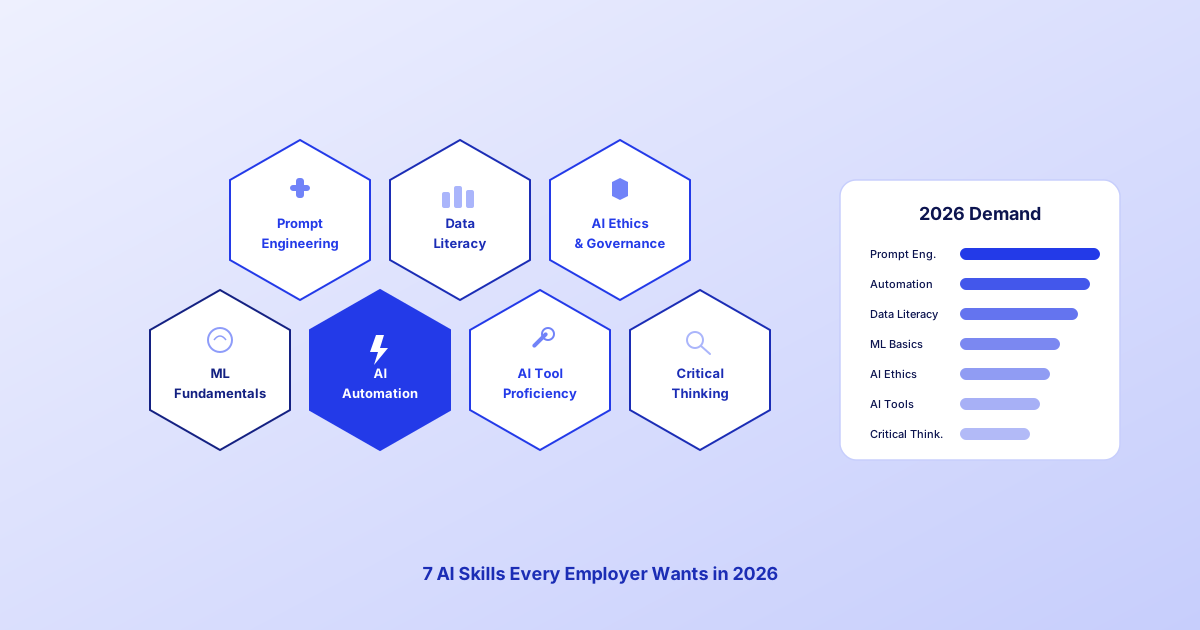
7 AI Skills Every Employer Wants in 2026
These are the 7 skills AI job postings keep asking for, and they're all learnable. Here's what each one means and how to build it.
Kareeo Team8 min read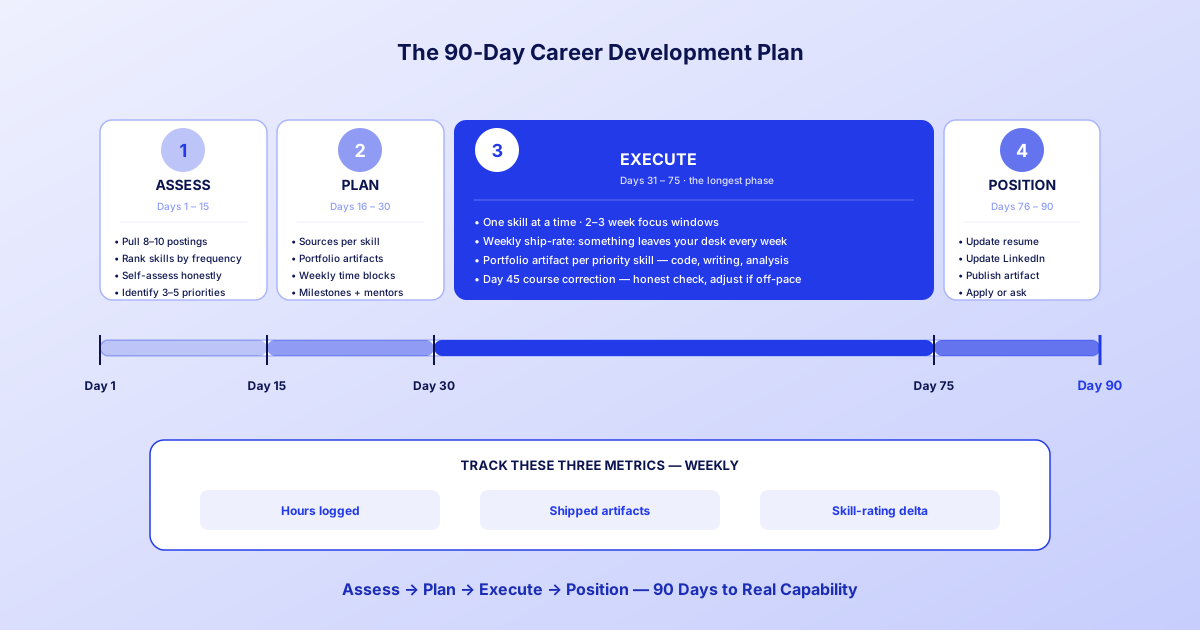
The 90-Day Career Development Plan: A Framework for Getting Promoted, Pivoting, or Leveling Up
Career growth without a plan is drift. Here's the 90-day framework that turns vague career ambition into concrete skill milestones — with templates for each phase.
Kareeo Team10 min read