The Resume Keywords You're Probably Missing in 2026 (By Role)
The same keywords get missed across industries, usually by candidates who did the work. Here are 20 phrases job postings ask for that resumes rarely use.

Kareeo Team
Career Content Team · · 7 min read
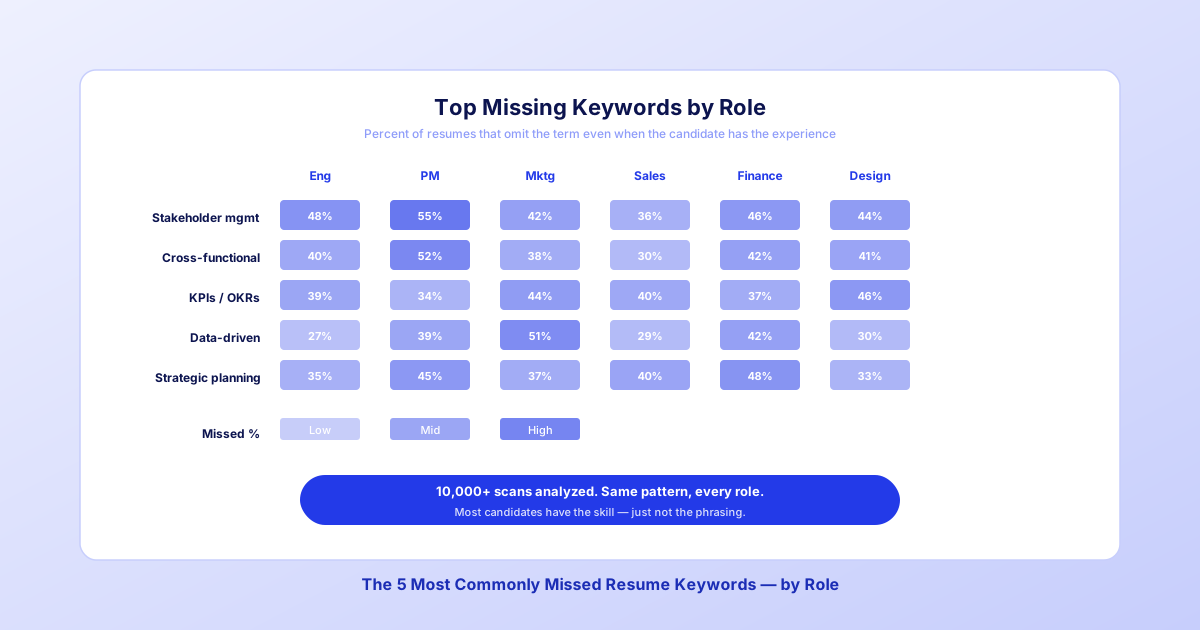
Here's an uncomfortable fact about job applications in 2026: the candidates getting filtered out aren't the least qualified. They're the ones who did the work but described it in different words than the job posting.
The same handful of keywords get missed over and over, often on resumes from candidates who objectively have the experience the posting is asking for. They just phrased it wrong.
This post breaks the pattern down by role, explains why specific phrases keep getting dropped, and shows how to add them back without inflating your resume.
Why Keywords Get Missed (Even When You Have the Skill)
Three patterns account for almost all missing-keyword gaps:
The "same work, different word" problem. You "led a project across design, engineering, and product." The job wants "cross-functional collaboration." Same work. Different phrasing. ATS doesn't connect them.
The "assumed context" problem. You're a VP of Engineering. You assume the hiring team knows you've used Git. You don't list it. The ATS filters on "Git" as a required skill. You disappear from the search.
The "outdated vocabulary" problem. You learned the skill five years ago when it was called one thing. It's now called something slightly different. Your resume still uses the old name.
All three are positioning problems, not capability problems. And all three are fixable in a 20-minute review.
20 Phrases Postings Ask For That Resumes Rarely Use
These phrases show up across job postings in nearly every industry. Most candidates do the work they describe and write it down some other way:
| Category | Phrase |
|---|---|
| Working across teams | Stakeholder management |
| Working across teams | Cross-functional collaboration |
| Working across teams | Executive communication |
| Working across teams | Change management |
| Measurement | KPIs / OKRs |
| Measurement | Data-driven decision making |
| Measurement | Quantitative analysis |
| Measurement | Root cause analysis |
| Planning | Strategic planning |
| Planning | Project scoping |
| Planning | Requirements gathering |
| Planning | Budget management |
| Process | Agile / Scrum methodologies |
| Process | Continuous improvement |
| Process | Process optimization |
| Process | Technical documentation |
| Operations | Risk management |
| Operations | Escalation protocols |
| Operations | Vendor management |
| Operations | Performance tuning |
If you're scanning that list and realizing you've done most of those things but haven't written them this way on your resume, you've just identified the fastest resume upgrade available to you.
Missing Keywords by Role
Different roles have different missing-keyword patterns. Here are the top 3 for each major role category:
Software Engineering
- System design - frequently absent even when the candidate has designed systems.
- Code review - assumed context, so it goes unmentioned.
- Distributed systems - skipped even by engineers who have worked on them.
Engineers tend to under-list methodology and communication skills. If you've ever explained technical tradeoffs to a non-engineering stakeholder, list that. If you've ever led a design review, list that.
Product Management
- Product-led growth - a newer term that many resumes predate.
- User research - omitted even by PMs who run interviews and usability sessions.
- Roadmap prioritization - usually written as "deciding what to build" instead.
See what the software sees in your resume
Upload your resume for a free diagnosis. It is parsed the way an ATS parses it, read the way a recruiter reads it, and you get the fixes ranked by what moves your score.
Get my free diagnosisFree to try. No credit card required.
Marketing
- Attribution modeling - rarely listed, even by marketers who own the model.
- Demand generation - usually written as "running campaigns" instead.
- Performance marketing - often replaced with the vaguer "paid marketing."
Marketing has moved toward precise technical vocabulary. Generic phrases like "campaign management" are weaker than specific ones like "lifecycle marketing" or "conversion rate optimization."
Sales
- Pipeline management - the work is described, the phrase is not.
- Quota attainment - usually written as "hit sales targets" instead.
- MEDDIC / BANT - the qualification framework goes unnamed even when it is used daily.
Sales resumes are often quota-heavy ("120% of quota, 3 years running") but framework-light. Adding the specific methodology you used makes a noticeable difference.
Finance / Accounting
- Variance analysis - performed routinely, listed rarely.
- GAAP compliance - assumed context, so it goes unmentioned.
- Financial modeling - often written as "building spreadsheets" instead.
Finance resumes tend to lean on tools ("Excel, Tableau") without naming the analytical frameworks. List both.
Design / UX
- Design systems - the work appears in the portfolio, not on the resume.
- Usability testing - described without the specific term.
- Information architecture - one of the most consistently omitted phrases in the field.
Designers often list software (Figma, Sketch) but not methodology. Both matter.
The "Stakeholder Management" Phenomenon
"Stakeholder management" is the phrase almost everyone earns and almost nobody writes down. Why?
Because almost everyone does stakeholder management. Any time you've explained tradeoffs to a customer, aligned with another team before a launch, managed expectations across leadership, or negotiated a scope reduction — that's stakeholder management.
But most people write about those moments as "worked with the product team" or "communicated updates to leadership." Recruiters searching for "stakeholder management" skip right past them.
The fix: when you're describing any work that involved more than your immediate team, explicitly tag it as stakeholder management. Not as marketing spin — as accurate description of the work.
The Seniority Trap
Senior candidates (Director+, VP+) have a specific keyword problem: they omit basic skills on the assumption that their title covers it.
A VP of Engineering applying for another VP of Engineering role writes about strategy, organizational scaling, and executive communication. She doesn't list Python, Git, or AWS — she used them 10 years ago and they feel beneath the role.
Unfortunately, ATS scoring doesn't know about seniority. It just looks for required skills. If the posting requires "experience with AWS" and her resume doesn't say AWS, she gets filtered — even though she ran the team that migrated the company to AWS.
Senior candidates need to include both the leadership-level keywords AND the core technical keywords. Not prominently. Just present.
How to Add Keywords Without Keyword-Stuffing
The wrong way: dump 30 keywords into a skills section at the bottom of your resume.
The right way: distribute keywords naturally across three surfaces.
Summary (3-4 high-priority keywords). The most important ones go here, phrased as real statements about your work.
Skills section (10-12 keywords). Prioritized by relevance to the target job. Grouped if the resume is long.
Bullet points (1-2 keywords per bullet). When you describe what you did, use the keyword phrasing naturally.
Example bullet, before: "Worked with product, design, and engineering to launch the new onboarding flow."
Example bullet, after: "Led cross-functional collaboration across product, design, and engineering to ship the onboarding flow redesign, improving new-user activation by 23%."
Same fact. Same length. Keyword added naturally. Metric included.
See what the software sees in your resume
Upload your resume for a free diagnosis. It is parsed the way an ATS parses it, read the way a recruiter reads it, and you get the fixes ranked by what moves your score.
Get my free diagnosisFree to try. No credit card required.
What Keyword Matching Doesn't Do
Two caveats:
First, keyword match alone doesn't get you an interview. It gets you through the ATS filter. The human reader still has to want to meet you. A heavily keyword-matched resume that tells no story about your work won't land.
Second, some job postings are themselves poorly written. They include keywords the actual hiring manager doesn't care about. Matching a poorly-written posting perfectly doesn't make you a perfect fit for the job.
Treat keyword coverage as necessary but not sufficient. Pass the filter. Then make the resume worth reading.
Your Next Step
Start with one job posting you recently applied to that didn't respond. Paste it into an ATS scanner alongside your current resume. Expect to find missing keywords that describe work you actually did.
Rewrite the resume to include the ones you genuinely have experience with. Re-run the scan. Then apply again to similar roles with the updated version.
That's the compounding effect of keyword awareness: once you see the pattern, it applies to every future application.
See what the software sees in your resume
Upload your resume for a free diagnosis. It is parsed the way an ATS parses it, read the way a recruiter reads it, and you get the fixes ranked by what moves your score.
Get my free diagnosisFree to try. No credit card required.
Frequently Asked Questions
- What are the most commonly missed resume keywords in 2026?
- The phrases that go missing most often are the ones almost everyone earns but few people write down: 'stakeholder management', 'cross-functional collaboration', 'KPIs/OKRs', and 'data-driven decision making'. They appear throughout job postings, and candidates usually describe the same work in different words.
- How many keywords should I add to my resume?
- Aim for 10-15 role-specific keywords naturally distributed across your summary, skills, and bullets. Don't stuff — ATS parsers detect keyword stuffing and some scoring systems penalize it. Each keyword should connect to a real piece of your experience.
- Do keywords need to match exactly or can I use synonyms?
- Match exactly when possible. ATS parsers do some fuzzy matching (Python → Python 3), but phrase-level matches are much weaker. 'Cross-functional collaboration' and 'working with other teams' are scored as different things by most ATS systems, even though a human reads them as the same.
Related Articles
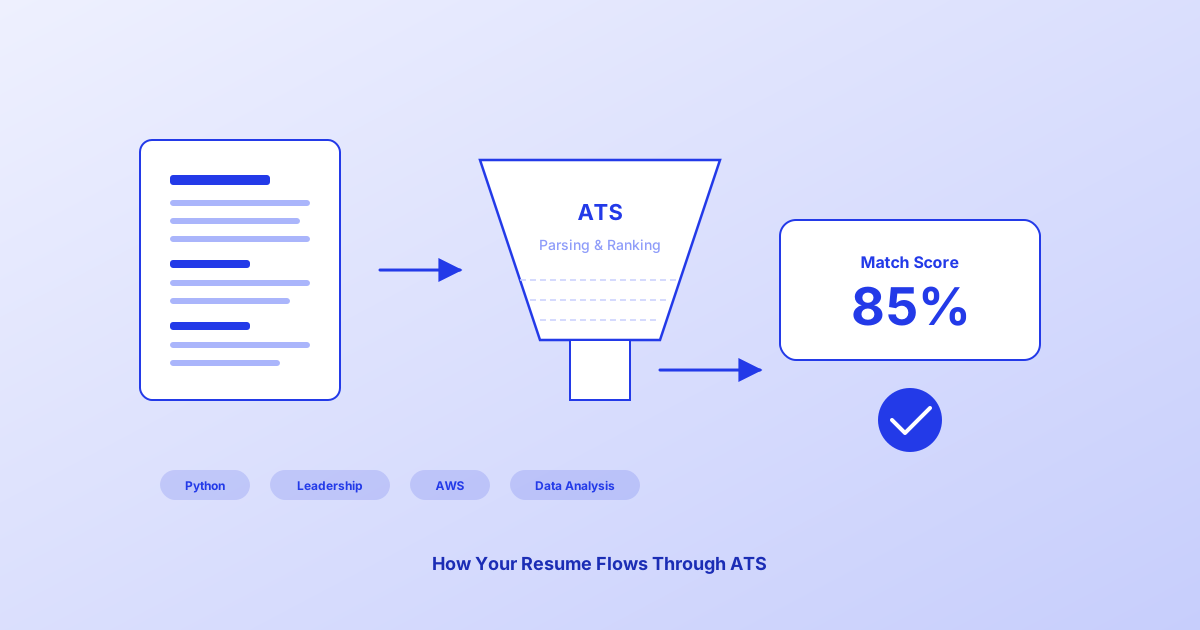
How to Pass the ATS in 2026: Getting Your Resume Through the Software Screen
Most mid-size and large companies screen resumes with software before a person reads them. Learn exactly how an ATS works and the fixes that make your resume hold up to it.
Kareeo Team6 min read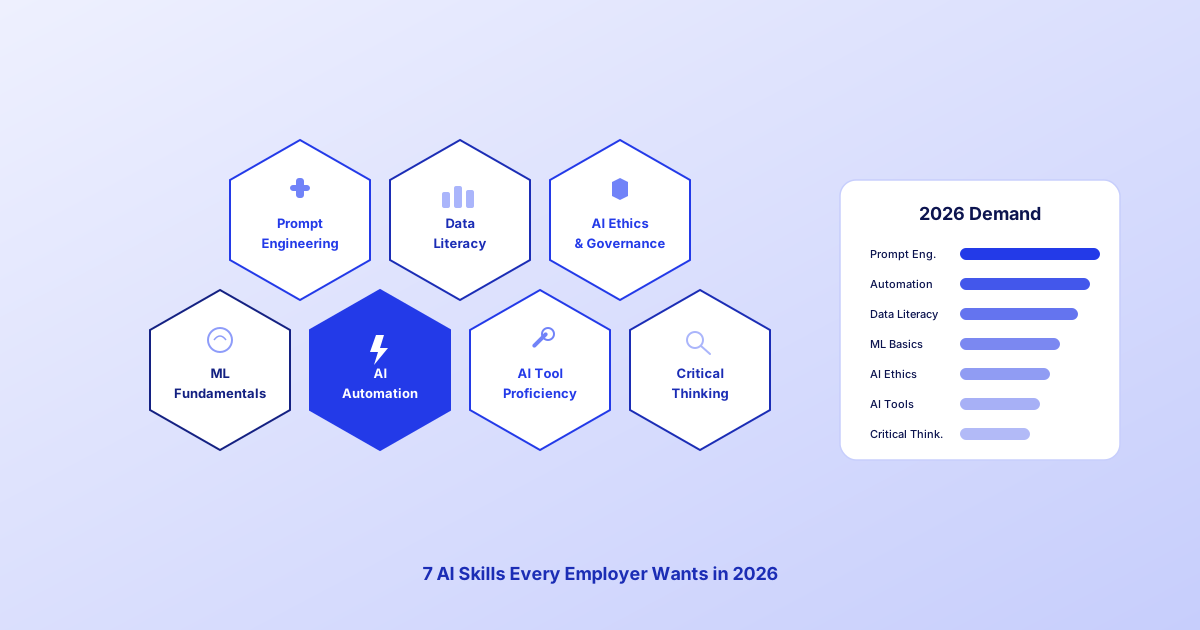
7 AI Skills Every Employer Wants in 2026
These are the 7 skills AI job postings keep asking for, and they're all learnable. Here's what each one means and how to build it.
Kareeo Team8 min read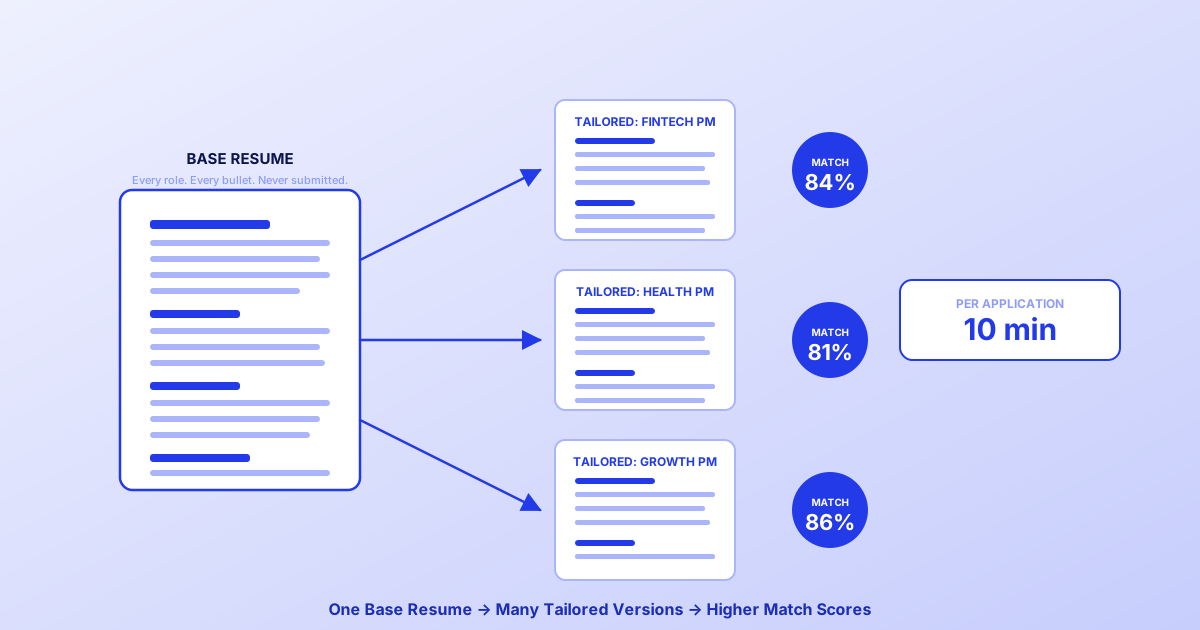
Resume Tailoring in 2026: How to Customize Your Resume for Every Job in Under 10 Minutes
The 10-minute workflow for tailoring a resume to each job from a base resume, with a before-and-after example of what changes and how to explain it.
Kareeo Team10 min read